Politics

Posted in Uncategorized | Comments Off on Politics

MP Again Calls for Dismemberment of Regional Councils

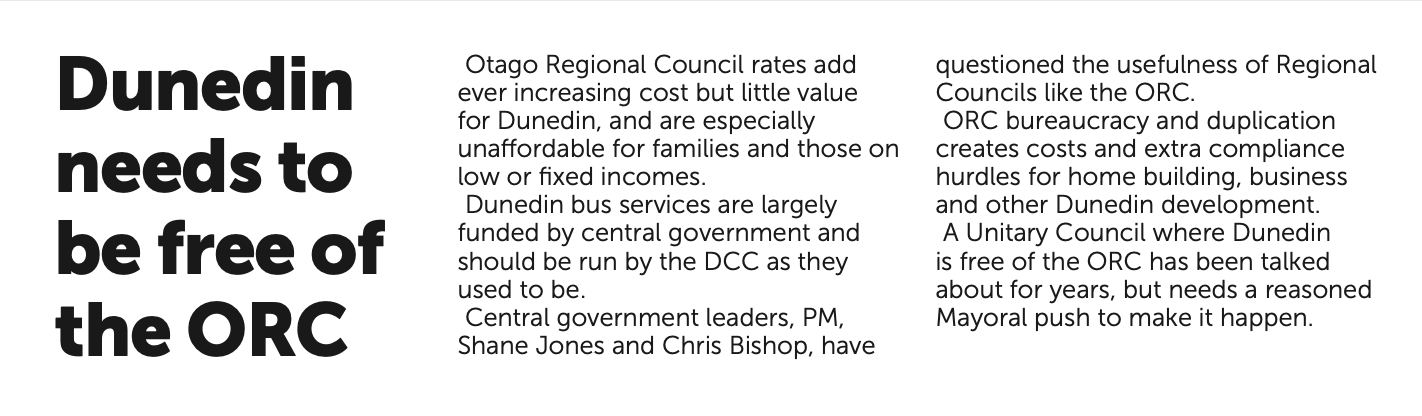
Shane Jones calls for the dismemberment of Regional Councils, having last month called out the ORC for stopping Macraes Gold expansion.

Getting Dunedin free of the Otago Regional Council can’t come soon enough, but needs a strong Mayoral push to make it happen.
Posted in Uncategorized | Comments Off on MP Again Calls for Dismemberment of Regional Councils

Latest ODT Mayoral story…

My specific proposals are in contrast to Cr. Barker’s aspirations.

e.g.

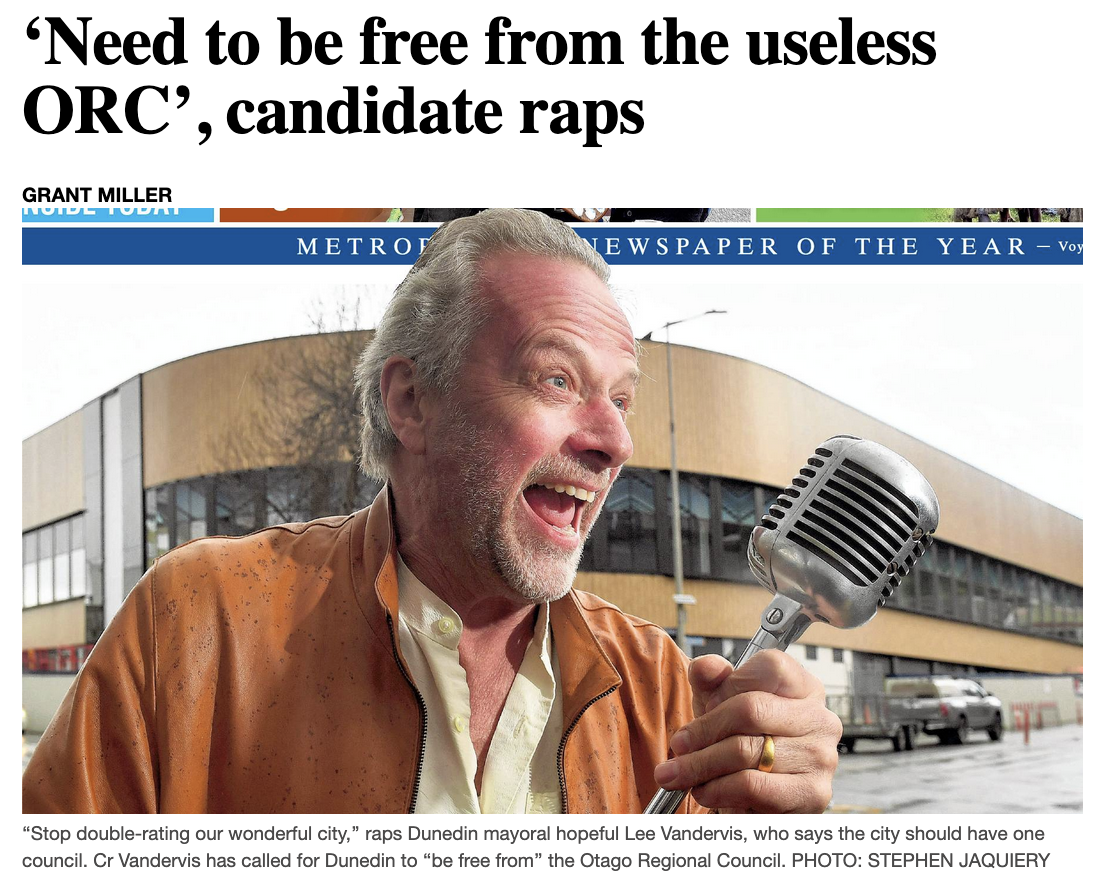
“Cr Vandervis: Dunedin needs to “be free of” the Otago Regional Council. “We need to reclaim our port and our harbourside.” A unitary council should be established in Dunedin. “Once we get this new model where we have a single council, we will then be able to lead the development of Dunedin in a way that hasn’t been possible in the past.”

Cr Barker: We need to “re-envision” the city. “I’ve been working on a bit of a vision, which is around the best place to live in New Zealand, where people live fulfilled lives in a connected city that’s safe and accessible for all, where our standard of living is enhanced by our treasured environment, a prosperous city with meaningful jobs and strong communities resilient to climate change, a smart city respecting heritage while innovating for our future.” Bold ambition is required, and a plan has to have smart, measurable goals.

Governance, leadership and accountable decision-making

Cr Vandervis: “As mayor, I intend to make sure that only relevant decisions get put in front of the council and that much of the submissions industry, much of the international politics and much of the virtue signalling that goes on at council simply doesn’t get on to the agenda in the first place.” He would push for slimmed-down meeting agendas. Better agendas should lead to better results.”

Posted in Uncategorized | Comments Off on Latest ODT Mayoral story…

ODT ad in Saturday’s paper

Posted in Uncategorized | Comments Off on ODT ad in Saturday’s paper

Today’s ad on the Star back page

Posted in Uncategorized | Comments Off on Today’s ad on the Star back page

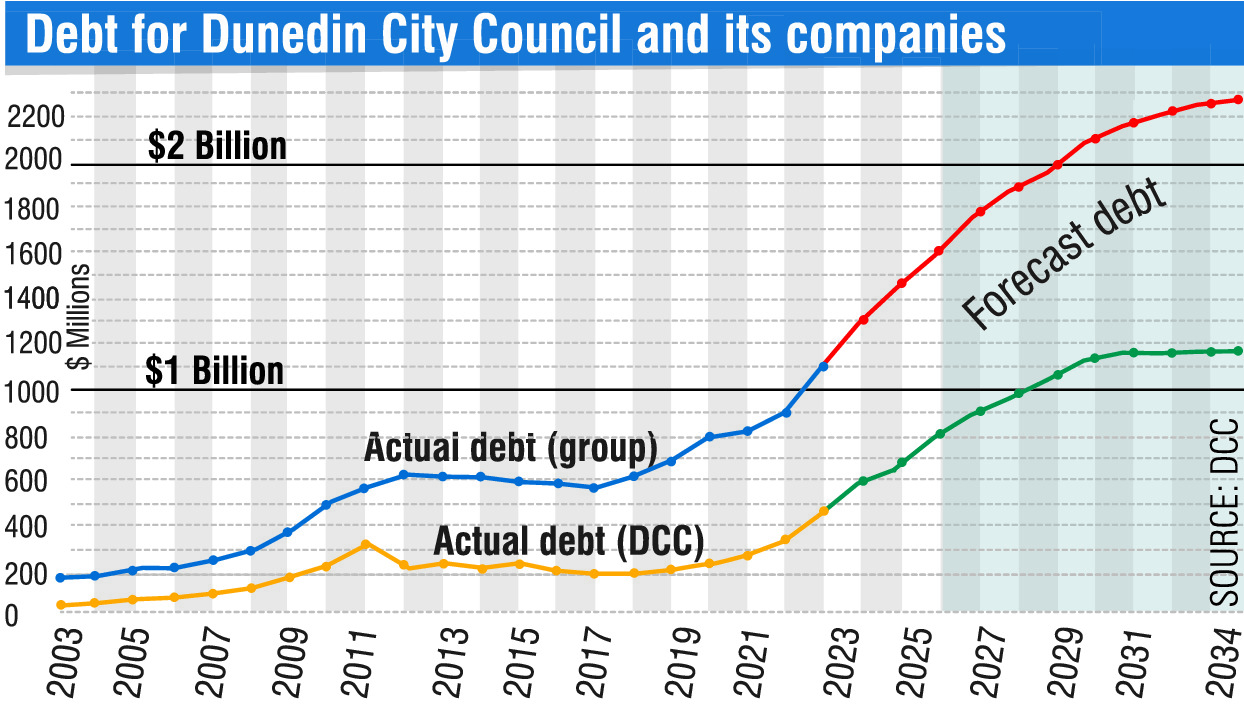
The ODT front page today has extraordinary information regarding Dunedin City Council Debt and claims made about it. This below is graph part of the story that I have long wanted exposed.

“The mayor’s suggestion “core” council debt would drop after five years was presented in council material as DCC debt excluding water, and this metric shows projected decreases from 2030.

Cr Vandervis described this as a “future fantasy”.

Mr Radich described Cr Vandervis as “sceptical” after many years at the council.

“I believe we are on track for debt repayment,” the mayor said.

“Anyone can see that core council debt excluding water starts dropping after five years and total council debt flattens, hence my contention that debt growth is under control when the LTP is looked at as a whole.”

Mr Radich had quite a different reading of the situation in February, when he urged councillors to avoid adding to the rising council debt that had already been included in draft budgets.

“We have been on a skyrocket trajectory of ever-increasing debt levels,” he said at the time.

“That is not sustainable and we don’t have to stay there.”

In March, S&P Global Ratings downgraded the council’s credit rating.
The rating of the council and its financing arm, Dunedin City Treasury Ltd, dropped from AA to AA- and the outlook for both organisations remained negative.”

My Debt Solutions include: back to basics spending, getting our Port Chalmers and Harbourside land back from the ORC (worth near $30 million per year), no more ORC rates, run better buses, get commercial returns from our Council- owned companies, sell-off unused or low-returning DCC land, improve staff productivity with University collaboration and AI, reverse recent $100+ million zerocarbon/cycleway splurge, pause $92.4 million Brighton Landfill, and use local contractors to keep Dunedin dollars and jobs in Dunedin.

Posted in Uncategorized | Comments Off on The ODT front page today has extraordinary information regarding Dunedin City Council Debt and claims made about it. This below is graph part of the story that I have long wanted exposed.

Business South and the Otago Daily Times together organised the most revealing and informative Mayoral Debate opportunity in many elections – 9/9/2025

Business South & Allied Media – Dunedin Mayor Candidate Forum | Otago Daily Times Online News

Posted in Uncategorized | Comments Off on Business South and the Otago Daily Times together organised the most revealing and informative Mayoral Debate opportunity in many elections – 9/9/2025

The Leading Mayoral contenders debate was well organised by Business South and the Otago Daily Times

Very happy with the ODT quotation of me from an informative debate last night.

“Cr Vandervis said Dunedin needed to ‘‘lose’’ the Otago Regional Council and restructure its own operation to be financially and environmentally sustainable.

The regional council was getting in the way of development beside the Otago Harbour, he said.

He wanted slimmed-down council agendas and a focus on land-use zoning to be pulled back.

Cr Vandervis and Mr Simms believed the council should get out of Local Government New Zealand.”

Posted in Uncategorized | Comments Off on The Leading Mayoral contenders debate was well organised by Business South and the Otago Daily Times

ODT – My Mayoral Profile printed on Saturday

LEE VANDERVIS 

Core services must be optimised

Age 70

Occupation Dunedin city councillor

Running for mayor and council

How should your council balance the need for infrastructure spending with concerns about rates rises?

Better contract delivery of Dunedin core services is needed to balance out-of-control rates, debt and bureaucracy. The DCC nine-year plan proposes rates rises many times the rate of inflation, plus billion-dollar-plus debt for most of the nine years, costing $1million PER WEEK just in interest! By cancelling $100-plus million carbon-zero and cycleways budgets and a $94m new landfill, we can optimise core services – drainage, sewerage, more parking and better road maintenance without raising rates or debt.

How do you envisage working with others in council – especially those who don’t agree with you?

Treating all councillors equally by abolishing name-only standing committees with chairmanships will reduce tensions and help enable consensus decisions. I will use mayoral powers to keep agendas free of world and national political issues, shorten and clarify with summaries using AI and get consensus through better information on just local core services decisions. Whether councillors agree with my wider political views or not should not be an issue.

What are your thoughts around the role of local and central government in NZ? What could be improved?

Dunedin needs to be free of the ORC. We need to return Port Chalmers and harbourside land to Dunedin, land that Dunedin ancestors reclaimed and developed for over a century before it was gifted to the ORC in 1989. Otago Regional Council rates add ever increasing cost but little value for Dunedin, and are unaffordable. A Dunedin unitary council free of the ORC has been talked about for years, recently by the PM and Shane Jones, but needs a strong mayoral push to make it happen.

What style of leadership is required for the city?

Decisive leadership is needed with a focus on core services, treating all councillors equally, not allowing waffling, virtue-signalling and central government political posturing in DCC meetings. As mayor I would ensure no-nonsense meeting behaviour, clarity on proposed budget and operational cost information, raise Dunedin’s profile nationally and internationally, attracting investment, streamlining DCC consents/compliance and freeing Dunedin of ORC duplicate bureaucracy.

What has the council got right and what are your priorities for change?

DCC has recently employed some highly skilled council companies directors and this year we received our first company dividend for a decade – $11m to offset rates increases, which I have pushed hard for. My priorities for change include better-value contracting, freedom from ORC rates and compliance costs, reduction of DCC paperwork using AI and clearer DCC focus on core services, resulting in the ability to control rates, debt and bureaucracy.

Posted in Uncategorized | Comments Off on ODT – My Mayoral Profile printed on Saturday

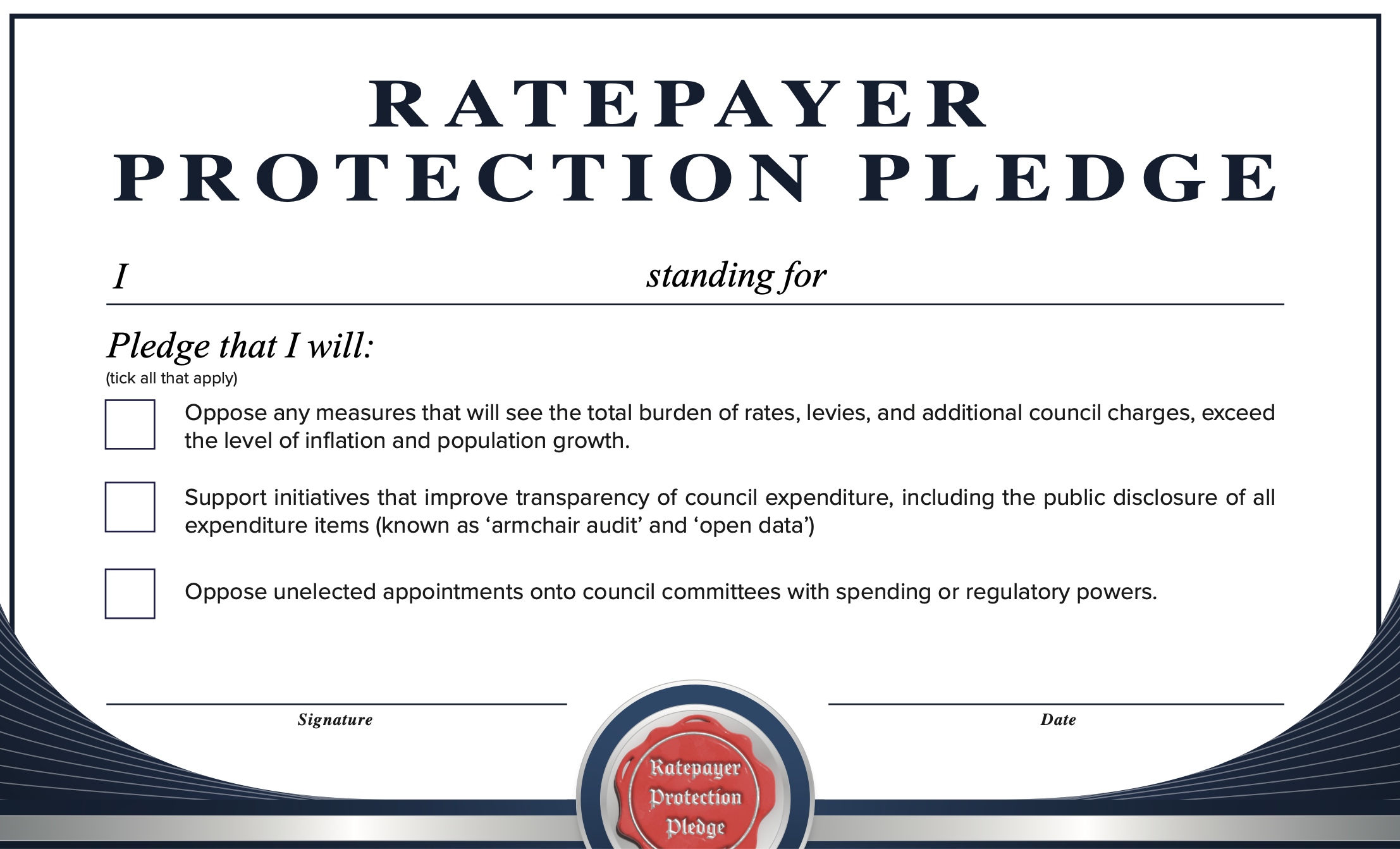
Taxpayers’ Union Pledge.

The Taxpayer’s Union have not got this Pledge right and have email-bombed Elected Representatives with it.

Subject: Re: Ratepayer Pledge: Can we promote you in our ‘How to Vote’ guide?

My reply –

Dear Sam,

I would have liked to sign the pledge for #2 and #3, but #1“exceed the level of inflation and population growth.” is two different numbers and dumb anyway because a rates cap without a debt cap is moronic.

I am Chair of DCC Finance and Council Controlled organisations and a long-term battler against these ludicrous Rates and DEBT increases mainly caused by poor value spending.

See leevandervis.com for details and DCC Debt graphs.

In answer to my publicly videoed 9 Year Plan question, ‘What would next year’s 10.7% rates increase need to be to cover budgeted expenditure without adding $120 million to the debt?’, the DCC Chief Finance Officer confirmed that the rates increase would have had to be 58%!

Our monopoly print media ODT did not put this on the front page, but you can check the DCC YouTube video yourself.

Rates cap without Debt cap is pointless as they are interdependent.

Kind regards,

Cr. Lee Vandervis
Posted in Uncategorized | Comments Off on Taxpayers’ Union Pledge.

ODT Mayoralty ad DCC DEBT and SOLUTIONS 23/08/2025

Posted in Uncategorized | Comments Off on ODT Mayoralty ad DCC DEBT and SOLUTIONS 23/08/2025

Today’s half page ODT ad

Posted in Uncategorized | Comments Off on Today’s half page ODT ad

Family Friendly Fruit Trees instead of ornamentals would cost little and create a productive Community asset.

For more than a decade I have asked DCC staff to plant at least some Family Friendly fruit trees since they plant hundreds of other trees annually, but so far without success.

As Mayor I will be able to push this catch-up with other NZ Cities much more effectively.

https://ccc.govt.nz/parks-and-gardens/edible-christchurch

https://sailorsforsustainability.nl/…/urban-gardening-nzl/

Posted in Uncategorized | 1 Comment

The Owner of Aurora Electricity Lines business does not set the price of electricity to consumers. The NZ Government sets the price.

What electricity lines company Aurora [currently owned by DCC] ‘can earn’ means what profit margin is allowed by the Commerce Commission for Aurora to charge customers.

This electricity cost to the consumer is set by the Commerce Commission and not by whoever owns the lines company.

Posted in Uncategorized | 1 Comment

WHERE for Dunedin’s household WASTE?

Exporting our waste seems wrong until you consider that most of our waste is imported in the first place, and that regional boundaries don’t recognise ideal waste disposal areas.
About 80% of Dunedin waste, mostly commercial is appropriately disposed of in local landfills like Nash and Ross at Burnside with only the putrescent household waste having to go to near-full DCC Green Island Landfill.
The ideal landfill geology for problematic household waste is a limestone quarry like AB Lime in Winton or the new limestone pit just south of Timaru. Sending our putrescent waste there makes economic sense since these facilities make money both selling limestone creating the easiest complying hole, and then charging for filling the hole with putrescent waste.
These limestone-quarry facilities have already invested all the hundreds of millions needed to have some 200 years of landfill capacity available. Why not use this existing capacity and save ourselves the $94 million estimated for Smooth Hill, an up-front cost which may well escalate.

The argument for spending $94 million on a new better Green Island facility at Smooth Hill could make sense if you assume that: 
1 – there will be sufficient waste quantity for the next 20 years to justify the massive up-front investment, 
2 – that interest rates will not go higher than 5%, 
3 – that the DCC can afford the interest and opportunity costs of burying $94 million in Smooth Hill, 
4 – that Smooth Hill will be run efficiently for at least 20 years, 
5 – that there will be no leakage or other environmental issues, and 
6 – that AB Lime or Taiko won’t set up their own competing waste collection points in Dunedin and undercut DCC’s Smooth Hill operation.

If any of these assumptions is in doubt, and most are, then Smooth Hill looks to be an avoidable $94 million financial liability at a time when our Billion$ debt is already unsustainable.
There is no plan to pay DCC or DCC Company debt down over the next 9 years, we still haven’t paid down the DCC $85 million Stadium debt after 14 years, and doing it on debt is the current spendthrift Council’s way of disguising real rates increases.

Like the emotional argument of not ‘exporting’ our waste, the emotional argument that we need to ‘have control’ of our waste is an illusion as well. My 18 year Councillor experience of DCC ‘control’ of the DCC Landfill has not been pretty. Green Island management has been out of control for some years, gas collection has been incompetent and out for control for other years, staff claims of the complete fullness of Green Island have been wrong repeatedly, and post landfill closure liabilities have also been misrepresented. 
Household waste disposal is constrained by increasingly difficult central government compliance and environmental legislation that is best anticipated by centralising reduced disposal volumes in the ideal geology of a limestone quarry. 
DCC Waste Minimisation policy is a direct threat to the viability of a Smooth Hill household waste facility which can only be viable with sufficient volume – volume which the DCC is aiming to significantly reduce.
Convenient as green-waste bins are for some, the DCC should be reducing green-waste streams by actively supporting composting at home, mulching rather than green-waste removal, and permitting on-site spreading of woodchip.
Having acquired the necessary consents for a Smooth Hill Landfill, some strategic dragging of the chain and seeing how waste stream volumes reduce and how Green Island fills for two years would be my cost-effective preference.
It would also allow us to see what the actual trucking costs are to a Limestone Quarry facility, and see if a better deal might be wrung out of AB Lime [second photo below] now that Taiko Landfill is also an option. 
My message to debt-doing decision-makers is that fools rush in, and if the ORC try to push DCC landfill spending along immediately, that would be another good reason to push for a Unitary Council. 

Posted in Uncategorized | Comments Off on WHERE for Dunedin’s household WASTE?

5 years of Scaffolding to Surround Town Hall.

I have been surprised that we have had little paperwork specifying what the $14 million Municipal Chambers restoration is being spent on, but we have been told verbally that significant spending was required, largely due to seismic strengthening of the main tower.
I have questioned the restoration cost and especially the timescale which we have been told will be 5 years which seems a ridiculously long time to have scaffolding up, especially since the Town Hall was built in only two years from foundation stone to opening, 100 years ago.

As a Councillor I have had little written information on the restoration project or on what the building structural assessment has revealed.
There was a Councillor tour of the building work progress some months ago that I did not attend.
It appears to me that DCC staff consider the restoration project to be an operational matter that they would rather elected representatives did not concern themselves with.
Endorsing the $14 million budget was a bit like endorsing the $15 million Edgar Center roof budget which I did question closely but was given staff assurances that re-pitching and insulating etc made for a very expensive estimate. Again, operational staff work that I believe elected representatives should be more involved in.
I have made some progress with independent inquiries into the Edgar Center roof, discussions with roofing contractors and others suggesting that the $15 million estimate is double what is needed.

I was disappointed to see the new garishly bright and ugly signage suddenly appear on the Town hall and Glenroy exterior a few months back without any forewarning, but I have not formally complained or asked of the cost of it yet as I have been focused on battling the new $120 million of new debt recently pushed through the 9 Year Plan.
Hopefully this garish signage is just temporary wayfinding around the scaffolding wall structures.

It appears that Council meetings will not return to the Municipal Chambers for 5 years, and I have no recollection of the appropriateness of the $14 million figure being debated or even discussed. Hopefully the new Council will address and question this proposed spend and hundreds of millions more in the 9 Year Plan soon after taking office in October.

Just in from DCC staff…
“Again, thanks again for your patience with this one. Here is a statement in response to your questions about the Municipal Chambers and Town Hall heritage restoration project.

If needed, please attribute to Group Manager Property Services Anna Nilsen.

There are two streams of work currently underway on the Town Hall and Municipal Chambers complex, one of which is the Exterior Heritage Restoration project and the other involves Seismic Investigation and Strengthening work. These are separate projects, but we are considering them together to ensure their interdependencies are managed. 

The heritage restoration project is being completed in four stages, with each phase focusing on different areas of the building. Plans for the first stage have already been developed in consultation with heritage experts and Heritage New Zealand. Most of Stage One focuses on two of the pavilions and the Municipal Laneway and Octagon façade of the Municipal Chambers building and involves the restoration of stonework, lead and copper flashings, timber repairs, and paintwork. The first stage is estimated to cost $2.7 million over the next 14 months. 

Planning for the later stages of the heritage restoration project is still underway. While work in each stage will be similar, we are unable to confirm the costs or an expected timeline until details are finalised. Alongside the restoration project, staff have been working with structural engineers to develop a detailed seismic assessment of the complex. This is to help identify what strengthening work might be needed and how much it will cost. The current budget allocated in the 9yp is to go towards the first stage of the Exterior Heritage Restoration project, and continue consultation work with heritage and engineering experts, and determine options for potential strengthening work and the planning for later stages of the exterior restoration work.

Councillors have been informed of the approach we are taking, and that staff will be presenting an update on how it is progressing (see excerpts from Council reports in January and May of this year).  We had planned to update Council in May, but staff needed to obtain more information to prepare the report. The report will now go to Council in either July or August. Once we have a better understanding of what strengthening work might be needed and the potential costs, Council will then decide on how to proceed with the project. The restoration work is a multi-year project and is likely to continue until at least 2028.

  •  

Report Exerts

Page 11 of 33 Capital Expenditure report 25-34 to Council 28/1/25

b)      Operational Property – $71.404 million. The major renewal projects under this portfolio are as follows. The first five projects on the list below are core city-wide emissions reduction projects. 

·            Town Hall and Municipal Chambers – $13.020 million, including $6.693 million for heritage restoration and seismic investigation, $2.987 million for the renewal of energy systems, and $1.824 million for a lighting upgrade programme.

Page 11 of 19 Capital Expenditure 9 YP 25-34 report to council 26/5/25

City Properties

1                There are two projects under this activity group that require additional budget in the 9 year plan, totalling $1.2 million, for the reasons described below (Table 15). 

1)      Municipal Chamber/Town Hall Restoration – $1.0 million additional. The project is nearing completion of discovery and planning for Stage One works. The main contractor has priced the work required to restore Stage One of the Municipal Chambers exterior. Negotiations with the main contractor have concluded, and final pricing is in the order of $2.7 million (including contingency). The budget has been updated to reflect this amount. Staff will bring an update report on this project to the Infrastructure Services Committee in June 2025. 

Kia pai tō rā, 

Kā mihi nui, 

Samuel White

KAIARATAKI WHAKAPĀ – COMMUNICATIONS ADVISOR
TE WHAKAPĀKA ME TE WHAKATAIRAKA – COMMUNICATIONS AND MARKETING 

03 477 4000″

From: Councillor Support <Councillor.Support@dcc.govt.nz>
Date: Monday, 21 July 2025 at 9:43 AM
To: Lee Vandervis <lee@vandervision.co.nz>
Cc: Council 2022-2025 (Elected Members) <council.2022-2025@dcc.govt.nz>, Executive Leadership Team (ELT) <elt@dcc.govt.nz>, Anna Nilsen <Anna.Nilsen@dcc.govt.nz>
Subject: Municipal Chambers and Town Hall Restoration

Kia ora Cr Vandervis,

Below is the DCC response to your questions regarding the Municipal Chambers and Town Hall restoration:

  1. Can you please confirm the verbal advice I have had that the Municipal Chambers and Town Hall restoration will require scaffolding already up, for a total of 5 years?

The scaffolding and construction barrier is up to support the Exterior Restoration and Seismic Investigation and Strengthening projects. The timeline for the projects is not confirmed yet, but it is expected that the Exterior Heritage Restoration work will be until at least 2028.

  1. Please also forward the annual cost budgeted of the scaffolding for this entire restoration.

The timeline for the projects is not confirmed yet, so we are unable to confirm the total costs for the scaffolding.

  1. Can you also please forward a summary of the scope of works anticipated for this 5 year restoration project.

A briefing report is scheduled to go to Council for consideration in July or early August. It will explain the scope of work in more detail then.

  1. Who commissioned the cold-white signage on the Town Hall and Glenroy, what was the cost of this signage, which business supplied the signage and is the signage intended to be temporary during restoration only, or permanent?

The construction barrier and signage installation were managed by Property Services. It was installed primarily for public safety however it blocked signage and wayfinding information. Staff worked with DVML to ensure signage met the needs of a function, events and conference venue. The new signage is temporary and will be removed at the completion of the projects.

Naylor Love are the main contractor on both projects, and they engaged Speedy Signs to supply and install the Lightbox signs.

The cost was $130,546.93 plus GST.

This included backlit signs as follows:

  • Concertina style sign outside the Cinema
  • Flat sign across the Moray Place main Town Hall Entrance
  • Concertina style sign at the corner of Harrop Street
  • Flat sign across the Glenroy Auditorium Entrance

Kā mihi,

Jackie Harrison

Manager Governance

Governance Support Office

Posted in Uncategorized | Comments Off on 5 years of Scaffolding to Surround Town Hall.

Can DCC and DCC Companies afford 2030 Carbon Zero? or is this just expensive virtue-signalling?

From: Lee Vandervis <lee@vandervision.co.nz>
Date: Thursday, 10 July 2025 at 9:36 AM
To: DCHL@dcc.govt.nz <dchl@dcc.govt.nz>, Council 2022-2025 (Elected Members) <council.2022-2025@dcc.govt.nz>, Sandy Graham <sandy.graham@dcc.govt.nz>
Subject: NZ Post follows Air NZ and Auckland Airport dropping climate targets as unachievable and unaffordable


Dear All,

NZ Post has [quietly] followed Air NZ and Auckland Airport dropping climate targets as unachievable and unaffordable. Perhaps we should reconsider our DCC and DCHL climate goals and the costs?
If we persist with unachievable and unaffordable, is this just expensive virtue-signalling?

Looking forward to your views,
Lee

“NZ Post is the latest company to drop its climate targets – another sign business is struggling to decarbonise

Published: July 9, 2025 2.08pm NZST

Author

  1. Pii-Tuulia Nikula

Associate Professor, School of Business, Eastern Institute of Technology

Disclosure statement

Pii-Tuulia Nikula does not work for, consult, own shares in or receive funding from any company or organisation that would benefit from this article, and has disclosed no relevant affiliations beyond their academic appointment.

NZ Post committed to cutting its emissions by 32% by 2030 (based on 2018 levels), but recently announced it would abandon its climate target.

The company was part of the Science Based Target initiative (SBTi), the leading international body allowing businesses worldwide to set and validate targets which they can then promote as backed by science.

More than 10,000 businesses have joined SBTi and the database currently includes 36 New Zealand businesses with active targets or commitments.

In recent years, however, well known businesses have been abandoning SBTi. NZ Post’s decision follows Air New Zealand’s announcement to withdraw last year and Auckland Airport’s less publicised decision not to renew its SBTi target.

NZ Post was one of the early adopters of SBTi in New Zealand. Its initial commitment in 2018 included not only the company’s own direct emissions (known as scope 1) but also purchased energy (scope 2) and other indirect emissions (known as scope 3, such as emissions from air freight or waste disposal).

In the past few years, NZ Post has signalled its intention to update its target to pursue even greater reductions of 42%. In 2023, it made a commitment to align itself with a pathway to achieve net zero by 2050.

Get news from New Zealand’s top academic experts in our free weekly email.

But the company has now decided to fully withdraw from SBTi. NZ Post’s website announcement states:

After careful consideration and a thorough assessment of both technical feasibility and financial implications, it has become clear that our target is no longer feasible at a technical level and, given the scale of investment required, under present economic conditions.

NZ Post seems to have found itself in the contradiction between economic objectives and climate action. Ambitious climate action seems to rarely win such a battle.

The company was already questioning its ability to meet its SBTi targets in its 2022 and 2023 climate disclosures. Its parcel volumes were growing and it struggled with emissions associated with heavy freight and aviation.

It also stated its emissions had increased due to the acquisition of Fliway Group, improved supply-chain data, and emission factor changes. This indicated it would struggle to meet even less ambitious climate targets.

Why this is a problem

One might commend NZ Post for their transparency in disclosing their decision to withdraw from SBTi. However, so far the announcement hasn’t been included in the company’s media releases and remains tucked away in the sustainability section.

The broader issue is that businesses can use SBTi to gain reputational value without following up with required decarbonisation. The current SBTi setup has some limitations that allow such behaviour.

For instance, companies can make an SBTi commitment and promote it for two years before having to submit an actual target for validation. Businesses can also promote their SBTi targets for years without making required progress. Finally, some SBTi businesses provide limited reporting, making assessment of their progress difficult.

In a 2025 consultation, SBTi acknowledged some of these problems and signalled its plan to enhance tracking and accountability.

Climate action vs profitability

There are other issues that make transparency limited. For instance, businesses such as Air New Zealand seem to be able to withdraw from the SBTi and fully disappear from the SBTi public target dashboard, making it difficult to track those that have decided to withdraw.

While most SBTi businesses are probably not joining the scheme with the intention of “carbonwashing”, the ability of many to meet their targets seems uncertain.

In business contexts, climate action remains subordinate to profitability and revenue growth objectives. Hence, not many businesses are willing to pursue all potential ways to meet their targets as this would require making difficult decisions around economic objectives.

Many companies struggle to make progress towards science-based goals or don’t have credible transition plans aligned with the goal to keep overall warming at 1.5°C.

The question remains whether the current SBTi engagement of businesses genuinely reflects ambitious climate action or whether it is merely designed to give stakeholders the impression of global progress through symbolic commitments.

In its 2024 climate disclosure NZ Post states:

The more organisations committed to the science-based reductions, the greater our collective ability to achieve decarbonisation.

The opposite is true as well. The decision of NZ Post and other companies to drop their SBTi targets may diminish the collective ability of businesses in New Zealand to achieve decarbonisation aligning with global climate goals.

SBTi’s plan to implement new monitoring and reporting mechanisms would enhance accountability. However, it will not make meeting targets any easier. Committing to and promoting ambitious but potentially unrealistic targets can cause reputational damage.

A safer pathway for many businesses wanting to do as much as they can within the boundaries of the current economic system may be a public disclosure of their support for climate action, transparency about the actions the business is taking, and providing transparent and detailed emissions reporting.”

Posted in Uncategorized | 1 Comment

Blue Sky thinking needed for Dunedin to progress.


My Mayoral plans to control Rates, Debt and Bureaucracy include:

Cancel recent Carbon Zero and Cycleway spending budgets [over $100 million],

Pause Smooth Hill landfill [$94 Million in budget], sending our putrescent waste, [less than 20 of Dunedin total waste stream] to a AB Lime in Winton or Taiko south of Timaru rather than to the hills above Brighton.
This short term as a trail would give us real costs and data to compare with the up-front millions needed to develop Smooth Hill.

Reduce staff costs by consolidating PR and support systems using AI, – information searches, quicker finance tools, decision analysis, comparative contracting, AI planning tools and automatic summaries promise much reduced workloads for DCC and DCHL staff.

Change ideological DCC Land Zoning to effects-based rules to reduce cost of housing sections and industrial land for development, – current zone restrictions do not recognise new technologies that allow off-grid electricity, off-grid small sewerage systems, and better roof water collection that would provide new housing opportunities without overloading existing electricity, water and drainage systems.

Unitary Council to free us from ORC bureaucratic duplication and stagnation, – Both MP Shane Jones and the PM have recently proposed losing Regional Councils as an unnecessary and unaffordable extra layer of bureaucracy. I have been promoting the benefits and cost/time savings of a Unitary Council for over a decade.
I proposed a unanimously agreed Council motion to investigate Unitary pros and cons, but was stifled by CEO Bidrose who did not do her job of carrying out the motion for two years, and then by Party politicians like Cr. Benson-Pope who managed to get Council to revoke the motion.

Sell Aurora and reinvest in diverse funds that will give us a decent return on this Billion$ investment, [unpopular but necessary]
We need to sell Aurora because the DCC is too indebted to keep providing the increasing levels of debt necessary to keep Aurora going and to keep up with Central Otago expansion needs.
Aurora itself is also too indebted itself to be able to raise the finance needed.
Consequently Aurora is worth a lot more to a wealthy investor than it is to Dunedin.
Mayor Radich has recently suggested a sale price between $1 Billion and $1.9 Billion.
What is certain is that we are paying $1 million PER WEEK just in interest costs on a BILLION$ DEBT.
It is no coincidence that the Chair and Deputy Chair of DCC Finance and CCOs along with all the DCHL directors see the sale of Aurora to an organisation that can afford to fund it as vitally necessary.

A reinvestment of Aurora equity in a diverse investment fund soon would be bankable and provide much needed relief from rates increases and current vulnerability to interest rate changes.
If Dunedin waits too long we risk seeing our biggest Company investment nationalised by Central Government for a fraction of it is worth, as Minister Mahuta almost succeeded in doing to our 3 Waters assets under Labour for less than 10% of their value.

Divide remaining companies into Commercial [to get commercial profits] or Community Enterprises,
– A commercial focus for Delta and City Forests would make regular commercial returns more easily available to Council.

Allow daily use of the Stadium to boost local sports, events, and conference use like the Edgar Center, – the delicate Stadium turf is enormously expensive to keep growing and needs weeks between events to recover, limiting use of the main pitch. It also needs airflow so that the Stadium skirts can not be lowered to keep the cold wind out.
A fully artificial turf is necessary if we are to get regular use of the pitch and something back for the 10 – 20 million annual running costs, which must be cut back rather than being bailed out every year by DCC.

New management model to boost number and range of Regent Theatre events/productions, –
The Regent is a big beautiful facility that gets little regular use because of the way it is run causing major promoters to refuse to bring shows there. For further details, talk to local promoter extraordinaire Doug Kamo.

Stop paying DCC Grants facilitators, overseers, managers, administrators etc. and go back to funding Community Projects only, run by volunteers.
DCC Grants run to many millions annually and there have long been questions about what value is achieved. Currently under review.

Freehold Harbourside land to allow development, – most of the Harbourside leasehold land is owned by ORC’s Chalmers Property, and attempts to get them to freehold land to allow Harbourside Development have long failed.
ORC’s Port Otago has also long failed to develop Port Chalmers sufficiently, still not developed inland ports [Port Napier has 3 Inland Ports] for more efficient ship loading after decades of talk, and won’t be ready for the new level of larger container ships that will only stop in one South Island Port, probably Lyttelton despite the seismic vulnerability of all the goods having to go through the one tunnel connecting Christchurch and Lyttelton Harbour.

Stop rate-paid international travel, limit conference travel, stop paying LGNZ SOLGM and any other local government spongers. Very easy savings of hundreds of thousands annually [LGNZ about 150,000 next year].

Sell unused or liability properties like Foulden Maar, Forbury Raceway, and many redundant pieces of DCC land. – the $1 million wasted buying land-locked Foulden Maar and then having to spend $100,000 more to cover it over because of toxic dust and fence it and keep people out has been a scandalous misrepresented waste of money in my view.


Ditto Forbury Raceway $13 million that has already suffered maintenance and vandalism costs with no plan of what to do with it, as the interest cost continues to drain finances.

Fast track business and development proposals, with more flexible compliance and permitted activity culture, – businessmen and developers have often met with me to complain of how difficult it is to build or grow a business in Dunedin compared to other places.
Dunedin Commercial rates are 2.5 times greater than Residential rates for similar services. In Invercargill they are the same.

Promotion of Dunedin at all levels of DCC and Company activity. – a whole new area of opportunities to market Dunedin much more cost-effectively.

Further cost-savings for Councils https://www.taxpayers.org.nz/102_ways


Posted in Uncategorized | Comments Off on Blue Sky thinking needed for Dunedin to progress.

DCC asked to help pay 14 year old Stadium debt

Additional details – Stadium debt of $85,000,000 has remained unpaid for the last 14 years.

The interest cost alone ongoing [assuming 5% interest rate] is $4,250,000 every year.

Enormous and increasing Stadium maintenance costs have varied markedly from year to year so are difficult to establish.

Both the ORC and DCC promised the Dunedin public in 2010 that the Stadium build would not go ahead unless they had an anchor tenant with the ORFU.

The Stadium never had a tenant agreed but both ORC and DCC went ahead anyway.

The initial annual Stadium rental to the DCC was agreed at $4 million per year. This would have covered just the interest cost early on assuming 5%, but in some early years interest costs peaked at 9.2%

This $4 million Stadium ‘rental’ has subsequently been reduced to $2 million and recently further reduced to $1 million.

It turns out that the Stadium can lose any amount of money annually and not be caught by ‘Trading while Insolvent’ legislation because the shareholder, the DCC can keep bailing out any amount of loses.

Progressively larger subsidies of Stadium operations by the DCC have included millions in annual large event subsidies, local event subsides, a one-off bail out subsidy of $2 million, and a massively reduced annual rates subsidy of about $1.5 million.

Despite pay-back of the Stadium debt being talked about for over a decade, no debt pay-back plan has been suggested as losses and maintenance costs continue to grow.

DCC and DCHL BILLION$ DEBTS continue to increase unsustainably by progressively larger annual amounts, [DCC up $120 million this year and an additional $121 million budgeted next year] again with no debt pay-back plan included in the recently confirmed 9 Year Plan…

Posted in Uncategorized | Comments Off on DCC asked to help pay 14 year old Stadium debt

Aurora DCC Lines Company needs to be sold and soon

Aurora needs to be sold and soon.

Jess Pen as below has accurately made the rational case for selling Aurora, but has not highlighted two main reasons why Aurora needs to be sold soon.

1 – the DCC is in far too much debt to finance and optimise the enormous potential of Central Otago development of Aurora.

The 9 Year Plan for DCC debt is to be paying 5% interest every year on approximately $1BILLION DEBT, costing $1 MILLION EVERY WEEK just in interest with no pay-back plan.

Aurora itself is so indebted it is unable to raise the development finance required itself and is losing its grip on lucrative Otago expansion of the grid to outside competitors like Southland’s Powernet.

Aurora needs an owner with deep pockets to buy and then further invest vast sums to realise Aurora’s full expansion value.

Dunedin citizens can consequently only get Aurora full value by selling it.

Dunedin can not afford Rolls Royce maintenance costs but needs a number of Toyotas to keep the DCC moving.

2 – Aurora should be sold soon for an optimum price as there is currently a lot of international money looking for a safe haven like a NZ lines company.

There is also the possibility of Aurora being taken over by Central Government, as was attempted when Labour’s Minister Mahuta tried to take control of DCC Water Infrastructure for less than 10% of its worth.

Strong public and elected representative opposition to selling Aurora was based on the public not understanding these debt/development/underfunding issues, not understanding the extreme financial vulnerability that Dunedin has to uncontrollable interest rates on unsustainable debt levels, and an understandable lack of trust in Councillors just wasting the sale proceeds.

Jess Pen

What was proposed was not to spend the proceeds from the sale of Aurora, but to establish a long-term investment fund that would generate returns for generations to come. The idea was to follow the model of large investment funds (think ACC who has 49 billion under investment) and invest the capital in a well-diversified portfolio of assets, and use the earnings to fund key services, infrastructure, or reduce rates. Had the DCC established such a fund, the benefits to the people of Dunedin would have been significant over many lifetimes:

– Lower rates over time, with investment returns supplementing revenue.

– Financial stability, protecting the city against economic shocks or future budget shortfalls.

– Long-term funding for core infrastructure, without increasing debt or deferring essential upgrades.

– Intergenerational equity, ensuring today’s $’s would continue benefiting future residents, not just the current council budgets.

Instead of a one-off spend, this approach could have laid the foundation for Dunedin’s version of a future fund working for the people. Who wouldn’t want that?

Posted in Uncategorized | 1 Comment