
Lee Vandervis
Draft Head Start Amalgamation Proposal – in my view this proposed dividing of Otago between Dunedin and Queenstown is just a self-serving attempt to delay the demise of the DCC.
The DCC amalgamation proposal with QLDC proposes two Otago Unitary Councils “supported by a shared regional services platform for functions requiring scale, specialist capability and regional coordination.”
Is it not true that almost all Otago Council functions will require scale, and/or specialist capability and coordination?
The two Unitary Councils then are essentially duplicate representation models cutting Otago in half but running the same shared functions with the only benefit being that we all get to keep our representation jobs and bureaucracies.
The draft claims that “The proposal builds on the strengths of Otago’s two principal urban centres – Dunedin and Queenstown”.
If we wanted to build on the strengths of urban centres, surely we would add Invercargill with 51,000 to Queenstown’s ’29,000’ against Dunedin’s 104,000 urban population?
Much of Queenstown’s urban population live elsewhere making it much less of an urban centre and more of a tourist/retail centre.
Invercargill is the other principal regional urban centre.
The ideal of a deal that “provides a strong platform for future growth, infrastructure investment and governance integration” would again surely point to an Otago/Southland Council rather than splitting Otago in two.
Our Central Government departments such as Health, Police, Justice, Corrections and Social services all operate in Otago/Southland as an integrated region, so how can we claim integration on a split Otago model?
The claim that “The proposal is deliberately evolutionary rather than disruptive” more honestly would be deliberately chain-dragging and keeping all our jobs, rather than the disruption that Central Government requires to lessen the social impacts of our unsustainably indebted, deferred-maintenance and dysfunctional 10 Councils in Otago/Southland.
As Cr. Simms has said, there is no evidence to support the idea that “Otago is too diverse for a single unitary authority today”.
The Otago Regional Council was an Otago-wide Regional Authority that kept our waterways under end-to-end management despite being in regular conflict with Otago’s Territorial Councils.
It is true that “The status quo does not provide the scale, resilience or simplicity required for the next generation.” but also true that it did not provide the scale, resilience or simplicity required for our current or our last generation either, and that it all needs to change significantly.
The twin Councils for Otago proposal claims “The key principle is straightforward:
Regional functions should continue to be delivered at regional scale, even where
democratic governance is organised through twin subregional unitary authorities.”
This key ‘principle’ is straightforward subregional self-preservation, and nothing more in my view.
The twin Otago Council proposal claim that ‘The proposal recognises the Ngāi Tahu principle of catchment-based environmental management’ is a blatant untruth as Cr. Simms has more politely suggested.
In short, this draft two Otago Councils proposal fails to be honest, forward-looking, or aware of the enormous development potentials of an Otago/Southland Region long plagued by 10 dysfunctional Councils.
Our Government Ministries already cover Otago/Southland as a unified region and the Highlanders represent Otago/Southland in International Super Rugby with colours: Blue (Otago), Maroon (Southland), and Gold (North Otago) – and so should a single integrated Otago/Southland Unitary Council.
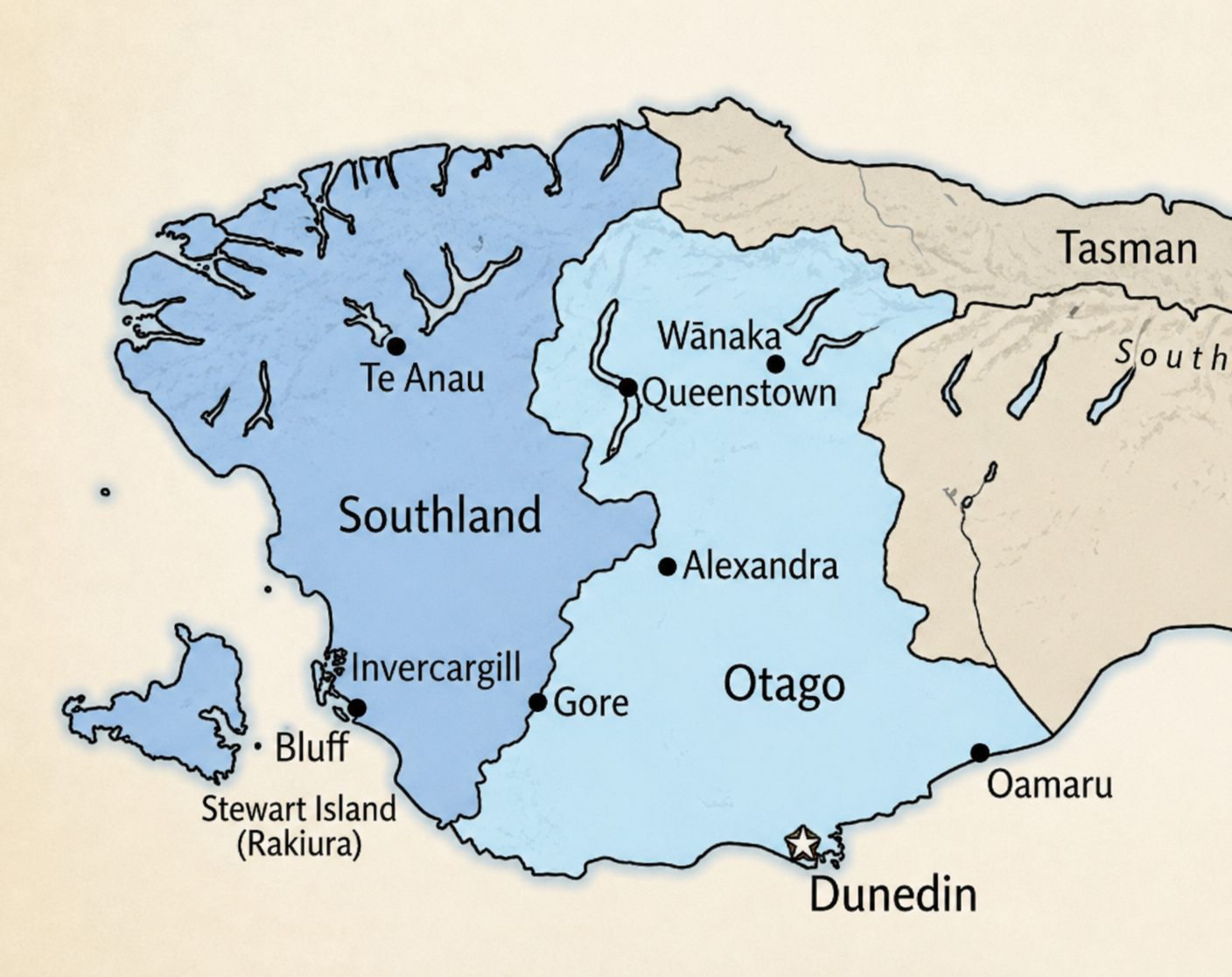
There are enormous win/wins for the whole Otago/Southland region with a new kind of Council that is not captured by left/right, urban/rural, or government-of-the-day agendas.
Representation fears are understandable, given the poor representation most of us now have with smaller Councils being captured by narrow interests.


