“Town Hall may need scaffolding for years | Otago Daily Times Online News (odt.co.nz)
Construction hoardings and scaffolding around Dunedin’s town hall complex could be in place for more than five years while remediation work is carried out.”
The Municipal Chambers only took 2 years for the entire build.
The Town Hall itself took less than 2 years to build, foundation stone 3 March 1928 – opened 15th Feb 1930 and was built without any debt!
From Wikipedia “The City Council’s profits from its trading departments during the 1925-1926 South Seas Exhibition enabled it to undertake the project and pay for it with cash”
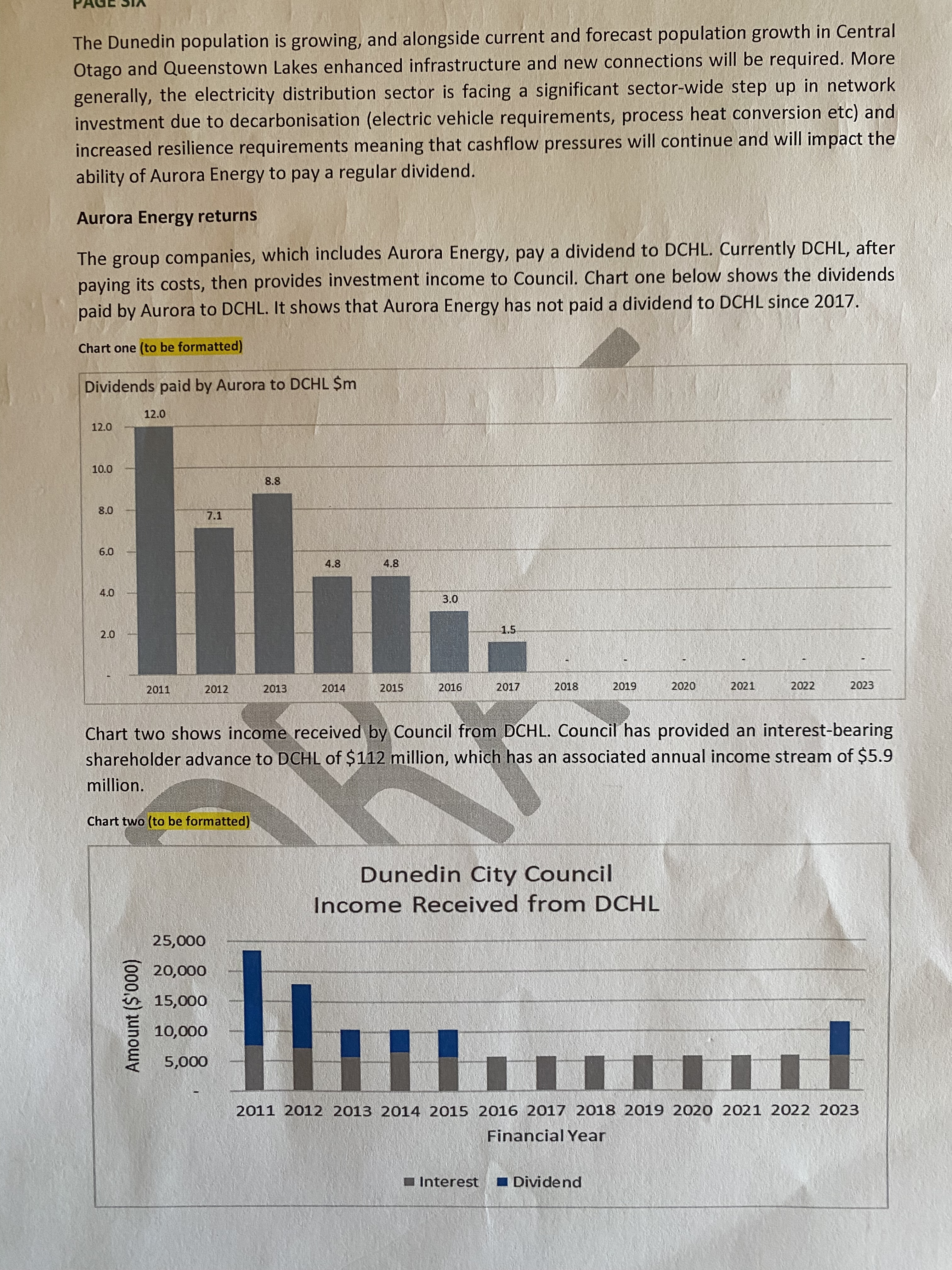
Finally we now have a proposal to get a return from this long dysfunctional public investment.
ODT 14/03/2024 “In 2021, Cr Lee Vandervis argued the council should consider selling some of its companies, including Aurora Energy. Cr Vandervis suggested the council allow another party to run the companies “properly, because we have failed”.
Full ODT front page story is published behind a paywall so I can not provide a public link.
Posted inUncategorized|Comments Off on DCC Electricity Distribution company Aurora issues have been noted on this blog since October 2019.
32 The draft operating budget for 2024/25 shows overall rates revenue increasing by $35.588 million, which is 17.5% higher than 2023/24. It is also higher than the rate increase of 6.0% provided for in the 10 year plan.
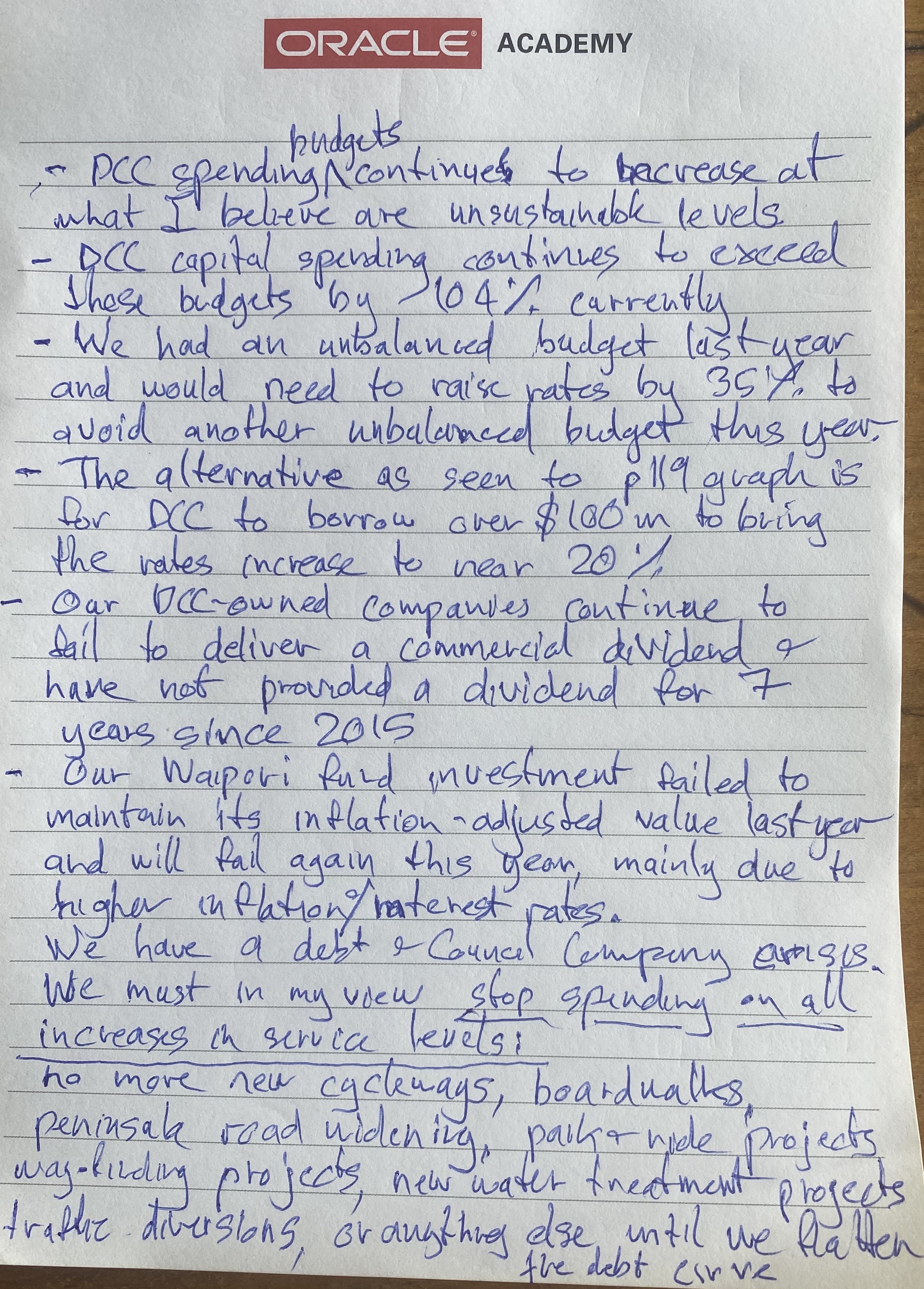
There is also an increase in debt of $117.554 million on the 2023/24 Annual Plan which temporarily avoids a much higher rates increase of near 35% and gives the DCC another unbalanced budget.
CEO Overview Report – Annual Plan 2024/25
Department: Civic and Finance
EXECUTIVE SUMMARY
1 On 16 February 2024, the Water Services Act Repeal Act 2024 (the Repeal Act) was enacted. Given the significant changes to 3 Water reform, the Repeal Act provides the ability to prepare an enhanced Annual Plan for the 2024/25 year, rather than completing a 10 year plan 2024-34.
3 This report provides an overview of the budgets to be included in the draft 2024/25 Annual Plan (the draft Annual Plan). The draft Annual Plan is an update of year four of the 10 year plan 2021-31. Draft Income Statements are at Attachment A, and draft Funding Impact Statements are at Attachment B.
4 This report highlights the budget challenges the DCC faces with the current economic climate of high inflation and interest rates. Savings have been found across the organisation, but these have largely been offset by rising costs.
5 The draft budgets propose a rate rise of 17.5% for 2024/25 which is higher than the 6.0% provided for in year four of the 10 year plan, and higher than the Financial Strategy rate limit of 6.5%.
6 Budgeted staffing numbers have reduced from 903 FTE to 852 FTE – a reduction in 51 FTE positions. All other controllable costs have been reviewed and reduced where possible.
RECOMMENDATIONS
That the Council:
a) Adopts the draft 2024/25 operating budgets for the purpose of community engagement as shown / amended at Attachment A.
b) Notes that any resolution made during this meeting relating to the 2024/25 Annual Plan reports may be subject to further discussions and decision by the meeting.
BACKGROUND
7 Following the enactment of the Repeal Act on 16 February 2024, at its meeting on 27 February, Council approved taking up the option of preparing an enhanced 2024/25 Annual Plan for community consultation, rather than preparing a 10 year plan 2024-34.
8 This decision was made following consideration of factors such as the changing legislative environment (both recent and signalled), and our need for more information that will allow us to prepare a more robust and informed 9 year plan.
9 The Local Government Act 2002 provides that Council must prepare and adopt an annual plan for each financial year. Section 95 (5) sets out the purpose of an annual plan as follows:
The purpose of an annual plan is to –
(a) Contain the proposed annual budget and funding impact statement for the year to which the annual plan relates; and
(b) Identify any variation from the financial statements and funding impact statement included in the local authority’s long-term plan in respect of the year; and
(c) Provide integrated decision making and co-ordination of the resources of the local authority; and
(d) Contribute to the accountability of the local authority to the community.
10 The Repeal Act provides that an enhanced Annual Plan is to include information additional to the Local Government Act requirements. The additional information includes financial statements and statement of service performance information for each group activity. This information will be included in the 2024/25 Annual Plan document adopted in June 2024.
11 The draft Annual Plan for 2024/25 is an update of year four of the 10 year plan. Budgets for the 2024/25 year have been reviewed and budget update reports for each activity of Council have been prepared for consideration at this meeting.
13 We continue to have the pressures of high inflation rates, increased interest costs – both rate increases combined with increasing debt levels, and the impact of asset revaluation on our depreciation costs. Interest is estimated to be up $6.1 million (23.3% on 2023/24), and depreciation by $5.2 million.
14 Many of the cost increases we are experiencing are outside of the control of Council, e.g., increased energy costs to run our pools and other facilities, insurance costs, and new costs such as compliance monitoring to meet water quality standards.
15 A rate increase of 17.5% is proposed in the draft budgets. This increase in rates will maintain current service levels but also pay for an increased level of service for a new kerbside collection service. This new service, commencing in July 2024, replaces the black rubbish bag system. Of the 17.5% rate increase, 4.4% will cover the cost of this new service.
Significant forecasting assumptions
16 The 10 year plan sets out a number of Significant Forecasting Assumptions. Assumptions relating to inflation and interest rates have been updated for the draft budgets.
17 Key assumptions included in the preparation of the draft budgets will be further updated in May 2024 if required. This will include but not be limited to:
· Interest rates on borrowing – including the allocation of interest costs to each activity group.
· Forecast debt as at 30 June 2025.
· The impacts of inflation.
· The level of grant funding from NZTA Waka Kotahi (if available).
Rates breakdown at a high level
18 The summary below provides a breakdown of the main factors making up the rate increase:
3 Waters 5.4%
Increase in depreciation (excl. 3 waters) 4.9%
New kerbside collection service 4.4%
Interest (excl. 3 waters) 1.8%
All other costs 1.0%
Total rate increase 17.5%
19 The breakdown is relatively simplistic and does not take into account the impact of increases in other revenue but does highlight the three main drivers of the rates increase. Broadly this shows that costs have been absorb where they can be, and savings found in an attempt to control discretionary expenditure. Fees and charges have been reviewed more critically, and rather than apply a blanket increase across these, many have been modified to reflect the actual cost of the services provided.
20 The increase in 3 Waters includes increased regulation and compliance costs to meet water quality standards, such as for chemicals and laboratory testing.
21 The increase in depreciation reflects the revaluation of some assets and the budgeted capital programme.
22 The Kerbside collection rates are for the new service starting in July 2024, replacing the current black bag system.
Capital expenditure
23 The draft capital budget for the Annual Plan provides for replacing existing assets and infrastructure. Across the Council’s activities, the proposed budget is $207.357 million in the 2024/25 year, compared to $157.044 million provided for in year four of the 10 year plan.
24 One area of uncertainty is the amount of co-funding that may be received from NZTA Waka Kotahi for budgeted transport activities. The draft Government Policy Statement on land transport 2024-34 has now been released for consultation purposes. It sets out the Government’s priorities for land transport investment. Staff are reviewing the draft Statement to understand the impacts it may have on our assumptions around co-funding for transport initiatives. Our findings will be reported to Council before finalising the Annual Plan.
Operating budgets
25 The draft operating budgets provide for the day to day running of all the activities and services the DCC provides to its community. These include 3 Waters services, parks, galleries, libraries, pool, and roading.
26 The rate increase of 17.5% included in the draft budget does not deliver a balanced budget, but provides for a net deficit of $25.655 million.
27 The revaluation of three waters infrastructure assets in 2022/23 resulted in a significant increase in depreciation. Since this time, the depreciation charge has not been fully funded, and Council has been running an operating deficit budget.
28 As part of the development of the 9 year plan 2025-34, a financial strategy will be prepared that addresses the issue of ongoing deficits, and provide for balancing the budget before the end of the 9 year plan.
29 Expenses within our control have been reviewed and the operating budgets show that savings have been made in many of the group activities.
30 The biggest area of increase in operating budgets is in the Waste Management activity. This significant increase in operating budget is primarily due to new contracts for the new kerbside collection service and monitoring costs required in the consent for the new Smooth Hill Landfill.
31 Each of the groups of activities have updated year 4 of their draft operating budgets as provided for in the 10 year plan. The key changes in funding sources and expected costs of delivery are discussed in the group operating budget reports.
Revenue
Rates
32 The draft operating budget for 2024/25 shows overall rates revenue increasing by $35.588 million, which is 17.5% higher than 2023/24. It is also higher than the rate increase of 6.0% provided for in the 10 year plan.
External revenue
33 External revenue has increased by $5.405 million, 5.9%. The main changes to external revenue are:
· Waste Management – a net increase of $2.553 million reflecting an increase in landfill revenue due to an expected increase in tonnage because of the closure of a transfer station and an increase in landfill disposal charges to cover expected increases in waste levy and ETS charges. Offsetting these increases, revenue from the sale of black rubbish bags ceases.
· Property – an increase of $877k due primarily to an increase in community housing rental.
· 3 Waters – an increase of $647k due to increases in fees and charges, including water sales and trade waste.
· Regulatory – an increase of $499k in fees to recover increased costs of processing consents and licenses.
34 Fees and charges are discussed separately in the group budget reports. Rather than apply a fee increase of 3%, as has been done in past years, fee increases for some areas are reflecting the increase in costs from the 2023/24 year.
Grants
35 Grant funding received from NZTA Waka Kotahi for transport activities is based on the nature of the planned capital works, and their eligibility for funding. It is also dependent on how much funding assistance is available, noting that there has been a shortfall in the Funding Assistant Rate in recent years.
36 The 2024/25 draft budget shows operating grants and subsidies revenue is down $2.499 million. The main changes are as follows:
· 3 Waters – operating grant funding has decrease by $4.400 million. The Transition Support Package funded by the former Government, set up to contribute towards transitioning to the now repealed Water Services Entities has been discontinued. In addition, Government funding for the 3 Waters Strategic Work Programme has been replaced by Better off Funding.
· Governance – operating grant funding has increased by $2.559 million, being the Government’s Better Off Funding package. This funding is being used for various projects across Council.
37 Capital grants revenue is down $3.697 million. The main changes are as follows:
· Waste – capital grant revenue has decreased by $670k. In 2023/24 grant funding was provided from the Ministry for the Environment for the purchase of bins.
· Transport – capital grant revenue has decreased by $3.067 million, based on the proposed capital programme and estimated funding assistance from NZTA Waka Kotahi.
Expenditure
Staff costs
38 The draft budget provides for an increase in personnel costs of $2.667 million, 3.3%. This provides for a union negotiated salary increase for staff.
39 The 2023/24 budget did not provide for a salary increase, and the negotiated increase was absorbed within existing budgets.
40 This saving has been achieved by vacancy management and a slow-down in recruitment. Vacancy management and a thorough review of budgets has resulted in the budgeted headcount reducing from 903 FTE to 852 FTE – a reduction in 51 FTE positions. Management of vacancies continues to be a priority, along with careful recruitment and looking after existing staff.
Operations and maintenance costs
41 Operations and maintenance costs have increased by $12.706 million, 16.5%. The main changes are due to the following:
· Waste management – an increase of $10.158 million relates primarily to the new kerbside collection service, increases in ETS costs and Green Island landfill costs, and additional monitoring for Smooth Hill and the implementation of the Southern Black Back Gull management plan, both required under the resource consent.
· 3 Waters – an increase of $2.311 million relates to plant maintenance cost increases, chemical and laboratory cost increases. There is a reduction in contractor fees, as government funding for the 3 Waters Strategic Work Programme ends.
· Transport – an increase of $737k, with $486k relating to costal management work, and $234k for an increase in bus shelters (fully recoverable from the Otago Regional Council) and State Highway maintenance (fully recoverable from NZTA Waka Kotahi).
· Parks, Galleries Libraries and Museums, Community and Planning, Property, and Economic Development have all made savings in their operations and maintenance costs. Further details are provided in each of the group budget reports.
Occupancy costs
42 Occupancy and property related costs such as rates, insurance and fuel have increased by $3.150 million, 9.7%. These increases have largely impacted the Property activity with an increase of $1.780 million and 3 Waters with an increase of $1.005 million.
Consumables and general costs
43 Consumables and general costs have increased by $1.822 million. The main changes are due to the following:
· Waste Management – an increase of $870k due to an increase in waste levy costs at the Green Island landfill, reflecting an increased tonnage in materials entering the landfill, offset by a reduction in costs relating to communications and marketing of the new kerbside collection service.
· Governance – an increase of $970k largely due to increases in software licencing fees of $743k.
Depreciation
44 Depreciation expense has increased by $5.215 million, 4.5%, reflecting the valuation of assets at 30 June 2023 and the capital expenditure programme. The increase is reflected mainly in the Transport, 3 Waters, Property, and Parks and Recreation activities.
Interest
45 Interest expense has increased by $6.118 million, 23.3%, reflecting the increase in debt funding required to support the planned capital expenditure programme and an increase in interest rates.
46 The 10 year plan 2021-31 had an interest rate assumption of 2.85%. The DCC’s current interest rate applicable to its borrowing is 4.66% as advised by Dunedin City Treasury Limited. For the purposes of preparing the draft Annual Plan, an assumption has been made that the borrowing rate for the 2024/25 year will be 5%.
Funding impact statement
47 The budget for each group, and all of Council, includes a Funding Impact Statement, as provided at Attachment B. Funding Impact Statements differ from Income Statements because they:
· Remove non-cash items such as depreciation,
· Separate operating and capital funding
· Include how total funding will be used, i.e., capital expenditure
· Identify how any shortfall in funding will be financed, i.e., an increase in debt.
48 Ideally the available operating funding being “Surplus/(deficit) of operating funding (A-B)” plus “Subsidies and grants for renewal expenditure” will be sufficient to cover capital expenditure “to replace existing assets”.
Funding Impact Summary
Budget 2023/24 $000
Draft Budget 2024/25 $000
Surplus/(deficit) of operating funding (A-B)
59,579
71,707
Subsidies & grants for renewals expenditure
8,012
11,840
Capex to replace existing assets
(138,077)
(101,139)
Increase in investment DCHL
(2,550)
(2,550)
Funding surplus/(deficit)
(73,036)
(20,142)
49 The table above shows that we are borrowing $20.142 million in the draft budgets to fund renewals. While this is not sustainable long-term, this will be addressed in a review of the Financial Strategy that will be prepared for the 9 year plan 2025-34.
Debt
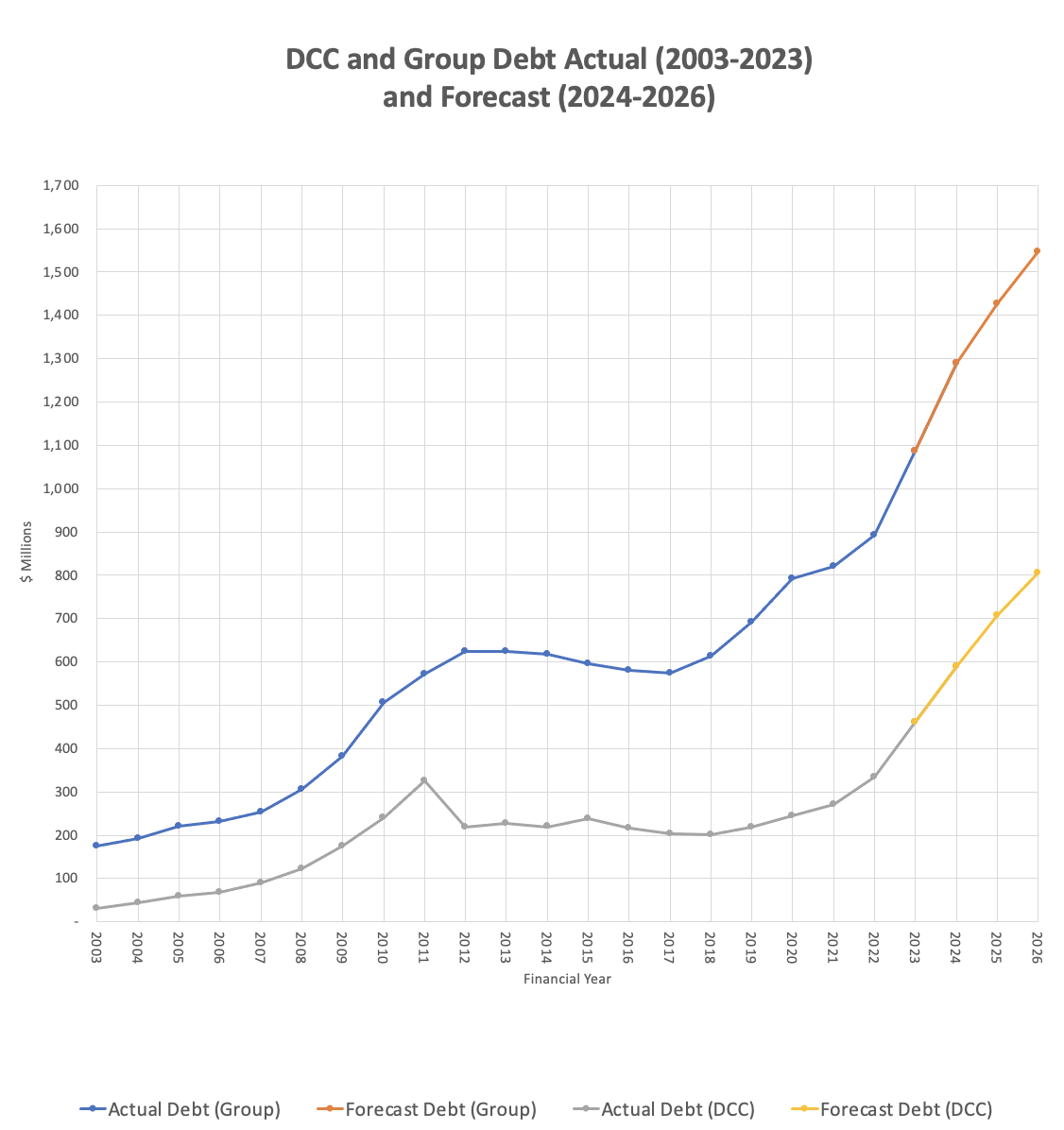
50 The Draft Forecast Financial Statements at Attachment C shows that by 30 June 2025, the estimated debt level will be $706.528 million which is 188.6% of revenue. The debt limit provided for in the current Financial Strategy is 250% of revenue. This is an increase in debt of $117.554 million on the 2023/24 Annual Plan.
OPTIONS
51 There are no options.
Signatories
Author:
Sharon Bodeker – Special Projects Manager Carolyn Allan – Chief Financial Officer
Authoriser:
Sandy Graham – Chief Executive Officer
Posted inUncategorized|Comments Off on DCC Rates latest budget for consultation
Future borrowing [already costing $1 million per week assuming 5.2% interest] for our BILLION$ DCC Group Debt is going to cost even more with a newly negative S&P Outlook rating. Future budgets already planned show this debt increasing by ANOTHER HALF BILLION by 2027 as the DCC Finance graph below shows.
As the new Chair of Finance and Council Controlled Organisations last year I moved to get the word ‘sustainable’ added into two key places in the DCC Financial Policy, which Elected Representatives readily voted for. Since then Council has continued to vote for unsustainable capital and operational spending at an unprecedented rate. Much of this increased spending has been on unproductive planet-saving transportation changes like cycleways and removing cars from the central City, along with CO2 monitoring and more compliance bureaucracy. Another unbalanced budget looms ahead of us along with unprecedented rates rises as a result.
As I have been warning for several years already, the inevitable is upon us and is predicted to get steadily even worse this coming year, especially for those with high levels of debt.
The ANZ is predicting the Official Cash Rate that that drives higher interest rates to increase to 5.75% shortly and then again to 6% mid-year.
On 1 February ODT readers were advised that DCC had purchased most of the former Forbury Park. No definitive purpose for the land was disclosed. I consider the purchase to be provisionally worthwhile, given the land’s potential to be used for housing, perhaps with a water feature, or as a reconfigured wetland. My personal preference is irrelevant.
Mayor Radich, Taieri MP Leary and the writers of this paper’s editorial of 3 february have enthusiastically backed the purchase, seemingly believing that stormwater flooding akin to what happened in June 2015 can be reduced or eliminated by diverting stormwater to what might be in future called Lake Forbury. It would appear that neither Mr Radich nor Ms Leary has considered how stormwater from across greater South Dunedin could ever find a pathway to the “lake”. There are no waterways across the floodplain, and gravity drainage is non-existent; hence the pumped drainage system that was installed in the early 1960s. It would presumably be possible to replicate such a system of pipes and pumps to divert stormwater to the “lake”, but this would surely be massively less cost-efficient that upgrading the existing system that feeds directly into Otago Harbour.
The writers of ODT’s editorial have unfortunately circumvented these difficulties by erroneously reporting a typical scenario for flooding across South Dunedin that has simply never occurred – and could not. The editorial refers to flood waves caused by heavy rain running down the hills and cutting across South Dunedin to the harbour. These, it is stated, can be intercepted by Lake Forbury et al. The reality is that the vast majority of stormwater flooding across South Dunedin is caused by rainfall intensities falling directly across the suburb that exceed the system’s capacity (around 7mm/hr, from memory and according to my analyses) over a reasonably pronged period. Flooding simply increases in depth gradually until the rain eases sufficiently. Any input from the hills merely adds to the pond. There are no flood waves to be intercepted.
The other key issue that seems to have been overlooked is the toxic nature of urban stormwater in general, and in South Dunedin in particular. Just ask anyone whose home was flooded in 2015. While industrial pollution would create something of an issue, the far greater concern would be the concentration of untreated sewage that inevitably pollutes South Dunedin floodwaters. The last thing that an expensively constructed water feature would need would be to be polluted thus risking the health of all its users, human or otherwise.
In my view, residents of South Dunedin should not therefore hold out much hope that any variant of “Lake Forbury” will reduce their flood risk to any meaningful extent. Instead, they may question why – at the time of writing, exactly 8 years and 8 months to the day – no material improvements have been made to South Dunedin’s stormwater infrastructure following the disastrous flood event of 3-4 June 2015.
Neil Johnstone (semi-retired professional flood control engineer)
Sing a song — or not I have never been able to sing. I remember well the groans of my teachers and classmates when I tried. But I would hate to be called a racist, therefore I have some sympathy for Cr Vandervis and wish him well in his endeavours.
Fay Lambert Wānaka
Glad tidings Roll on 2024 I say. My faith in mankind and commonsense is being gradually restored after reading today’s front page of the ODT (8.1.24). Having answered my query from a previous Letter to the Editor printed last year where I questioned the cost relating to the University of Otago’s sculpture that was unveiled (amidst all the doom and gloom being reported of their failing financial position and demise of courses along with academic personnel), I was heartened to read today the ODT had its own questions relating to the same and went a step further under the Official Information Act — bravo. Further in the paper there were three letters to the editor backing Cr Lee Vandervis — commonsense does prevail. I applaud the writers and their reasoning and agree wholeheartedly. A great start to my day.
Joyce Yee-Murdoch Cromwell
22/01/24 A nonsense Duane Donavan (ODT, 11.1.24) correctly calls Cr Laufiso’s personal campaign against CR Vandervis “vexatious and a waste of council time.” or, as an earlier correspondent put it, “spending her time screaming at the sky, pretending to be offended on behalf of Māori.”
There are bigger things for the councillor to be concerned about. The continual loss of parking in the central city is just one example. George St, the one-time “golden mile” is no longer golden. Fed-up shoppers are going elsewhere, leaving struggling businesses in their wake; some even closing up.
Then there are ever-increasing rates, a real worry for those on fixed incomes. They won’t be impressed at their dollars being splashed out on an investigator following up Cr Laufiso’s complaint. A nonsense if ever there was.
G R MacDonald Dunedin
Posted inUncategorized|Comments Off on Mouthing Maori, money and Monet code of conduct complaint –
Please accept this letter as a formal complaint against Cr Lee Vandervis under the Dunedin City Council Code of Conduct. The Councillor’s emailed letter, (dated Thursday, 12 /10 / 2023, attached below, Page 4-4, labelled Email Message 1) responded to an emailed message from Ms Nicola Morand, Manahautū – General Manager Māori, Partnerships & Policy (Acting) advising all members of Te Pae Māori as to the agenda for our Monday October 17th meeting being held at Ōtākou Marae.
The Councillor’s le
Subject: Te Pae Māori Agenda
Dear All,
I note a Te Pae Maori agenda under our DCC letterhead that does not conform to a normal DCC decision-making agenda as I believe is required under the Local Government Official Information and Meetings Act 1987, particularly Part 7 Local Authority Meetings.
The 3 items on this proposed agenda are devoid of any information, background, discussion, reports, or recommendations, and appear to be non-public without non-public specification.
As such I do not believe that any decisions made under such an agenda can be valid or binding. Please accept my apology for this meeting. Kind regards,
Cr. Lee Vandervis
Date: Sunday, 17 October 2023 at 10:05 PM
From: Lee Vandervis lee.vandervis@dcc.govt.nz To: Sandy Graham Sandy.Graham@dcc.govt.nz Cc: Sophie Barker sophie.barker@dcc.govt.nz Council 2022-2025 (Elected Members); Jeanette Wikaira
Dear Sandy,
I object to the Te Pae Maori Council agenda presentation lack of translations [again], the compliance requirements for entering this Council Hui meeting at Karitane, the co-governance and leadership references in the Principles that we are invited to agree to, and the no-option presumptive wording in the Maori Ward document that reads “
i) Agrees to a decision to establish a Māori ward prior to November 23, 2023,” when it should read i) Agrees to a decision to establish a Māori ward or not prior to November 23, 2023.
Words that must be translated into English in order for non-Maori speakers to be able to comprehend this future-repercussions Principles document include:
Te Pae Māori
Kāti Puketeraki ki Huirapa Rūnaka
Te Rūnanga o Ōtākou
Mataakwaka
TIMATANGA
WHAKAWHANAUKATAKA
Puketeraki ki Huirapa
TRONT
Manatu Whakaaetaka
mana to mana
whakapapa
Tapu and Noa
Tikaka and kawa
Regarding Karitane admission requirements detailed verbally at last week’s non-public meeting, I am not prepared to submit to the sexist, racist and tribal ritual requirements that have been spelled out in order for me to be able to enter “safely” on this marae.
I am a long-term hi-polling elected representative of all the people of Dunedin and I am not prepared to be dictated to in an official Council meeting by an elite claiming to represent 0.67 % of our voting public as detailed in the ward document.
The invitation to confirm co-governance status on this same elite, referred to in the document “Co-design, co-management,” is undemocratic on (sic) my view.
4
The suggestion that this voting minority’s representatives is confirmed by Council as having the primary “Key Direction –
Māori are leaders in the management of our natural resources and built environment” again supplants Democratic fundamentals and there is no surviving ‘Maori built environment’ for Maori to be leaders in the management of.
In summary, this decision-making hui agenda is not understandable by non-Maori speakers, is being held in a Tribal environment that excludes sovereign non-compliant elected representatives, is anti-Democratic and has a presumptive option to “i) Agrees to a decision to establish a Māori ward prior to November 23, 2023”
Until an understandable agenda is supplied with acceptable attendance criteria, I am not prepared to attend what I see as an inscutable (sic) further extension of the Maori MOU that I voted against as undemocratic at the beginning of this triennium.
Regards, Cr. Lee Vandervis EMAIL MESSAGE 2 ENDS
5
EMAIL MESSAGE 3 BEGINS
DATE, TIME: TO FROM SUBJECT LINE: Dear Cam,
3/08/2023, 11:17 AM Cam McCracken cam.mccracken@dcc.govt.nz, Director DPAG Toitū Lan Yuan & Olveston Lee Vandervis <lee@vandervision.co.nz> Inappropriate Maorification of one of our gallery’s most significant artworks
6
As head of our Dunedin Public Art Gallery, I am disappointed to have to ask you to remove the irrelevant Maorified text by Bridget Reweti pictured below beside one of our Gallery’s most significant artworks, Claude Monet’s ‘La Debacle’.
Even more disappointing has been to learn that you have chosen to ignore a similar request from a member of the public over a month ago.
Monet’s famous ‘La Debacle’ painting has no relevance or connection to: Te Tiriti o Waitangi, the Native Land Court, demolishing Maori social systems, or the MP of the time who claimed “we could not devise a more ingenious method of destroying the whole of the Maori race than by these land courts. The natives came from the villages in the interior and have to hang about for months in our centres of population… the result is that a greater number contract our diseases and die.”
Please remove this text promptly and replace it with relevant text commentary/explanation such as this interesting example which first popped up in my internet search of Monet’s famous painting;
*Title: The Break-up of the Ice (La Débâcle or Les Glaçons)
* Label Copy: The winter of 1879 – 80 was one of Europe’s coldest on record and Monet, who was living in the small town of Vétheuil, witnessed first hand the devastation when the frozen Seine river thawed, dislodging large ice floes that inundated the countryside and damaged bridges. In this painting, Monet explores two contrasting aspects of painting: spatial recession and surface patterning. As the Seine recedes at the left, Monet’s vertical reflections and horizontal floes superimpose a painterly grid that brings the eye constantly back to the surface of the canvas. The exploration of this tension between depth and surface was one of the defining concerns of his career. This debacle of the Seine was the subject of about twenty paintings that Monet worked on into the early spring of 1880. These paintings of ice floes chart Monet’s early fascination with capturing the same motif under differing conditions of light and at different times of day. They were produced over a period of months, while Monet’s later series such as those of haystacks, poplar trees, and Rouen cathedral, were extended investigations of the ephemeral effects of light on a motif during ever-narrower time frames some as brief as fifteen minutes in duration. [cid:image001.jpg@01D9C5FB.E145EE20] Looking forward to your prompt removal of this Maorified irrelevance and replacement with text relevant to one of our Gallery’s most significant artworks. Regards, Cr Lee Vandervis EMAIL MESSAGE 3 ENDS
EMAIL MESSAGE 4 BEGINS
SENT: WEDNESDAY, OCTOBER 4, 2023 6:11:06 PM From: Lee Vandervis <lee@vandervision.co.nz> To: Bill Acklin <Bill.Acklin@dcc.govt.nz>; Council 2022-2025 (Elected Members) <council.2022-2025@dcc.govt.nz>; Sandy Graham <Sandy.Graham@dcc.govt.nz> Cc: Ken Tipene <Ken.Tipene@dcc.govt.nz>; Jeanette Wikaira <Jeanette.Wikaira@dcc.govt.nz>; Robert West <Robert.West@dcc.govt.nz>; Sharon Bodeker Sharon.Bodeker@dcc.govt.nz Subject: Re: Waiata prep for Te Pae Maori [- cultural appropriation added by Councillor Vandervis]
Hi Bill,
You say in your email below that “ it is only right that we are able to deliver Waiata…in a formal environment to the best of our ability.” I disagree. I believe that it should be optional for elected representatives to sing Amazing Grace, Waiata, The Internationale or any other song as each elected representative sees fit.
I also think learning Te Reo or NZ sign language should be optional, and that all our decision-making should be in plain English, or with proximate English translation, so that everybody knows what ‘other language’ agenda words actually mean. I reject your claim that it is ‘only right’ to expect elected representatives to sing at all, leave alone in a language that most of us know little of the meaning of.
I am happy for other Councillors to spend our time singing even though I see it as a waste of time, but I am not prepared to submit to what I consider to be cultural appropriation and being expected to go to Waiata School.
28 November 2023 Dunedin City Council Chief Executive Officer/Tumu Whakarae Sandy Graham Sandy.Graham@dcc.govt.nz
Dear Sandy
Notice of motion
1 You have requested legal advice on the notice of motion promoted by Councillor Laufiso, dated 20 November 2023. In particular you have asked whether procedurally this can be considered by Council at its meeting on 28 November 2023.
Legal advice
2 It is our assessment that the notice of motion is now properly included on the agenda. It is the role of Elected Members to consider and vote on the merits of it at their meeting.
3 This is because it is the role of the Mayor to supervise the procedure and decide whether to direct to refuse any proposed notices of motion from being included in the Council agenda. This proposed motion has not been refused by the Mayor following discussion of it and advice from the Chief Executive. It is now for Elected Members to consider this motion and make a decision on it.
Reasons
4 A notice of motion is a means by which any Elected Member can have a proposed motion included on Council’s agenda. This is addressed under clause 26.1 of the Dunedin City Council Standing Orders. This requires notice of an intended motion to be in writing, signed by the mover, stating the meeting at which it is intended to be considered and delivered to the Chief Executive at least five clear working days before that meeting. Having reviewed the notice by Councillor Laufiso, we consider that it satisfies these procedural requirements. We note it was accepted by you as Chief Executive and was considered to comply with this procedure.
5 There is a discretion in clause 26.2 of the Standing Orders for the Chairperson (here the Mayor) to direct the Chief Executive to refuse to include a proposed notice of motion on the agenda. Clause 26.2 sets out criteria which may justify the Chairperson to refuse any notice of motion in their discretion.
6 We note from your instructions that upon receiving the notice of motion you took advice on it from the Governance team, then advised the Mayor. The Mayor has not made any direction to you as Chief Executive to refuse to accept the notice of motion. This means that the proposed motion has not been refused and has rightly been included on the agenda for Elected Members to consider and vote on.
7 It is clear that this proposed notice of motion is a matter of high political interest at the present time. In this context of a proposed motion on a political topic, we are satisfied that the Mayor having not refused the motion has made a decision reasonably available to him.
8 We have ourselves now assessed the grounds in clause 26.2 of the Standing Orders. We note that it is the exclusive role of the Mayor to form a judgement about whether any of these criteria are met to inform the exercise of the Mayor’s discretion. The context of that evaluation here is that this matter is of high political interest with limited alternative options, and limited implications (if any) for Council workload or budgets.
9 We comment below on the more relevant grounds in clause 26.2. We are satisfied that the notice of motion does not obviously contravene any of the criteria that ought to justify the Chairperson to refuse the notice of motion for procedural reasons. In particular: 10 It is for Elected Members to evaluate as part of their decision whether they have a sense of the views of persons likely to be affected or have an interest in the matter. It is for the Mayor to exercise a discretion to control the procedure about whether a notice of motion such as this goes on the Council agenda. Having not directed the Chief Executive to refuse this notice of motion, we consider it has now passed this procedural point and it is for the Elected Members collectively to consider the notice of motion, debate it, and vote on it as proposed. Yours faithfully nderson Lloyd
It appears that Mayor Radich has approved the addition of the Palestinian flag Notice of Motion being added to tomorrow’s DCC full Council agenda, and is too busy in China Sister City sight-seeing to respond to my email as below, leaving Deputy Mayor Lucas to deal with the fall-out.
The subsequent dropping of the inflammatory ‘fly the Palestinian flag from Mayor’s balcony and other City buildings’ motion in favour of NZ flag at half-mast helped defuse this waste of local government focus and time.
Subject: Palestinian flag-raising notice of motion
Dear Mr Mayor,
Re Cr. Laufiso’s Notice of motion part 2 calling for agreement “to the City’s flying of the Palestinian flag on November 29th on the Mayor’s balcony and other city buildings, the UN Day of Solidarity with the Palestinian People, as a tangible and visible symbol of support to our local Palestinian community.”
I believe you should refuse this notice of motion as Chairperson of Tuesday’s meeting under Standing Orders Section 26.2:
“(a) is disrespectful …“ [and indeed abhorrent] to a sizeable proportion of our Dunedin community.
and “(b) is not related to the role or functions of the local authority or the meeting concerned;”
The role of the DCC is not to purchase flags to fly from city buildings and the Mayor’s balcony to show solidarity for just one side of an international conflict.
[I note that Cr. Laufiso is as publicly avowed communist who, if this transgression of Standing Orders is allowed, would then also be able to call for the flying of the Russian flag from your balcony and city buildings in solidarity with the military invaders of Ukraine.]
and “(e) fails to satisfy sufficient information as to satisfy the decision-making provisions of s.77-82 LGA 2002;
Cr. Laufiso’s notice of motion fails to provide any information, leave alone sufficient information to satisfy any elected representatives’ decision to show solidarity with just one side of the Israel/Palestinian/Hamas conflict.
Your powers as Chairperson of this meeting are sufficient on any of the counts (a), (b), and (e) of DCC Standing Orders above to simply refuse the entire notice of motion in my view, and I intend to propose that this be done upon the confirmation of the agenda, if you do not use your Chairperson’s authority to refuse the notice of motion prior to Tuesday’s meeting.
I believe that in this way we can maintain an orderly and relevant meeting without having to consider a disrespectful ‘solidarity’ motion with one particular side of an international conflict that lacks sufficient information, and is outside of our functions as a NZ local government Council.
Electoral (Lowering Voting Age for Local Elections and Polls) Legislation Bill
General policy statement
The Electoral (Lowering Voting Age for Local Elections and Polls) Legislation Bill (the Bill) is an omnibus Bill introduced under Standing Order 267(1)(a). That Standing Order provides that an omnibus Bill to amend more than 1 Act may be introduced if the amendments deal with an interrelated topic that can be regarded as implementing a single broad policy. The single broad policy implemented by the amendments in this Bill is to reduce the voting age in local elections and polls from 18 to 16 years of age.
The Bill amends the Local Electoral Act 2001 so that persons aged 16 or 17 years are eligible to vote in local elections and polls; it does not change the voting age for parliamentary elections. The Bill establishes a new category of electors, named youth electors, and provides for 16-year-olds and 17-year-olds to be registered on a youth electoral roll.
However, although it lowers the voting age to 16 years for local elections and polls, the Bill does not change the age for—
· being elected or appointed as a member of an alcohol licensing trust or trustee of a community trust:
· voting in the election of members of an alcohol licensing trust:
· voting in the election of trustees of a community trust:
· serving as a juror.
The relevant age for those activities remains 18 years.
from Wikipedia:
“In New Zealand a person is considered a child or “minor” until the age of 20. On reaching this “age of majority” the person is no longer a child in the eyes of the law, and has all the rights and obligations of an adult.[2] There are laws to protect young people from harm that they may be subject to due to their lack of maturity. Some legal age restrictions are lifted below the age of majority, trusting that a child of a certain age is equipped to deal with the potential harm.[3]For example, 16-year-olds may leave school, and 18-year-olds may buy alcohol.”
…and of course vote at 18 with the NZ voting age having been progressively reduced from 21 over the last few decades.
I am old enough to have seen our 8 children grow up and become variously politically aware, and my experience of this combined with information as above strongly suggests to me that voting by most teenagers is unlikely to be well-informed and that younger people are more likely to vote responding to media or peer pressure, not having had enough years/experience to work out what government is about and what is in in societies’ best interests. There are exceptions of course, but voting age Laws have.to draw a line somewhere.
Posted inUncategorized|Comments Off on Some of my reasons for voting against further lowering of the voting age to 16 in Local Body Elections:
From: Lee Vandervis <lee@vandervision.co.nz> Date: Thursday, 21 September 2023 at 10:33 PM To: Lynne Adamson <Lynne.Adamson@dcc.govt.nz>, Council 2022-2025 (Elected Members) <council.2022-2025@dcc.govt.nz>, Sandy Graham <Sandy.Graham@dcc.govt.nz>, Executive Leadership Team (ELT) <elt@dcc.govt.nz>, Robert West <Robert.West@dcc.govt.nz> Subject: Re: Council Agenda
Dear All,
Item 21. Climate change significant forecasting assumptions – 10 year plan 2024-34 has included many forecasting assumptions, but fails to identify the most fundamental and important assumptions in my view. These assumptions resulting in expensive climate mitigation strategies have significant cost implications for our Council Controlled Companies and our ratepayers.
Throughout, emissions are loosely assumed to be CO2, when in fact N2 and H2O are a much greater percentage component of vehicle emissions than CO2.
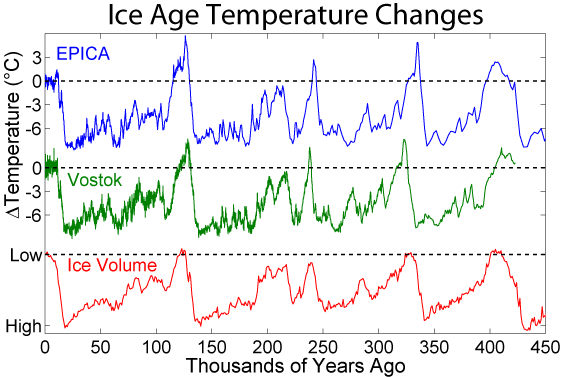
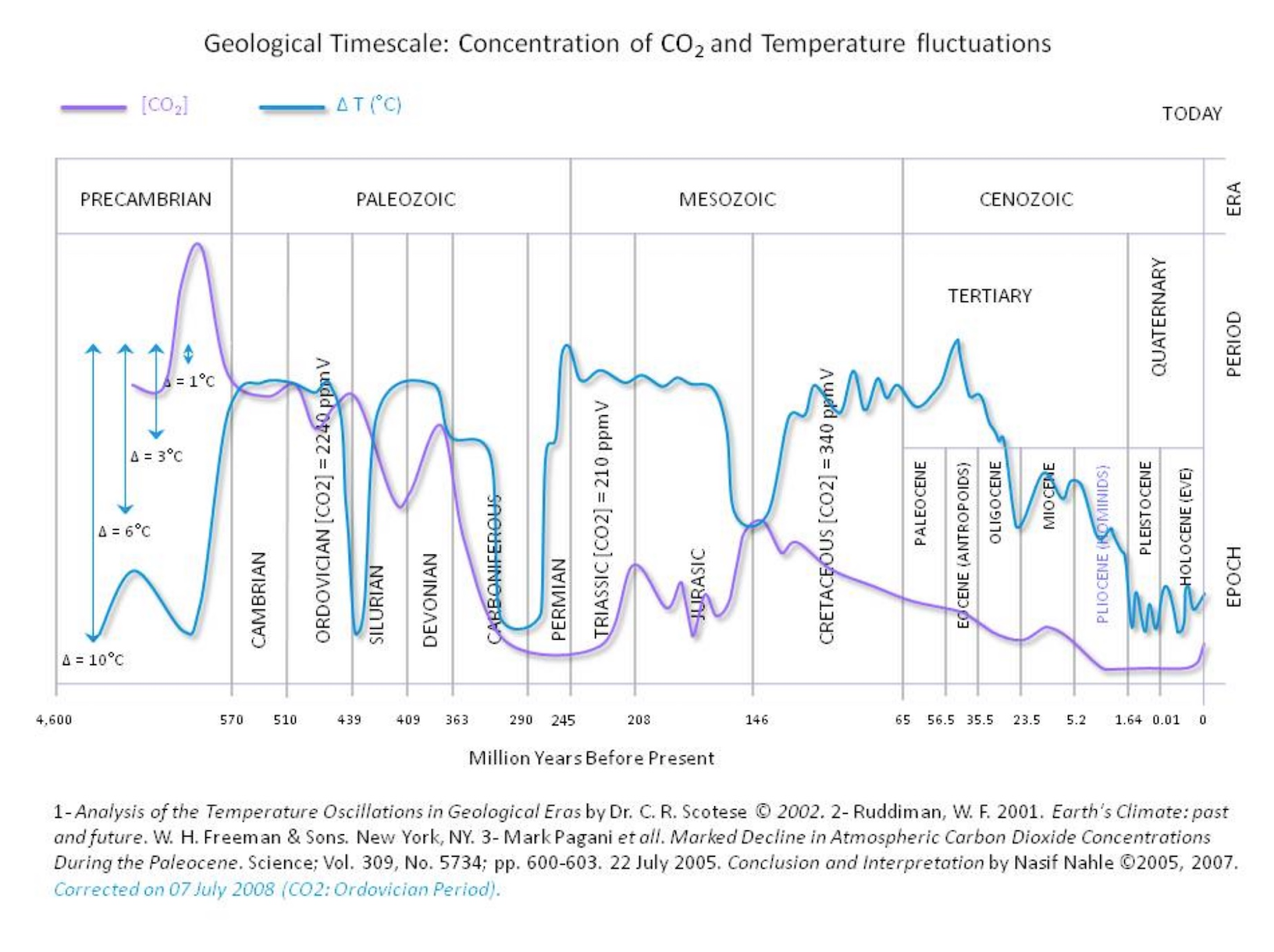
Throughout it is also assumed that CO2 is a greenhouse gas, higher levels of which cause global warming. No long term evidence has been available to me to prove this causality, and all the verifiable evidence I have found shows that increasing CO2 levels can not be causal of increasing world temperature, because historically there have been long periods when CO2 was high and temperature low, and other times vice versa, as the following graph shows.
There has never been a causal connection between CO2 levels and world temperature levels in the past, so why would CO2 suddenly be causal now, just because we are releasing previously sequestered CO2 from fossil fuels back into the atmosphere? If there is any better or alternative long-term CO2/Temperature evidence available, please let us see it to justify this most fundamental assumption.
Another assumption in this Item 21 is that increasing CO2 levels also contributes to more extreme and dangerous weather events, an assumption that is easy to assume without evidence if you follow main-stream-media. In fact the last 100 years of dangerous weather events has seen a significant reduction in climate catastrophe deaths as the following data shows:
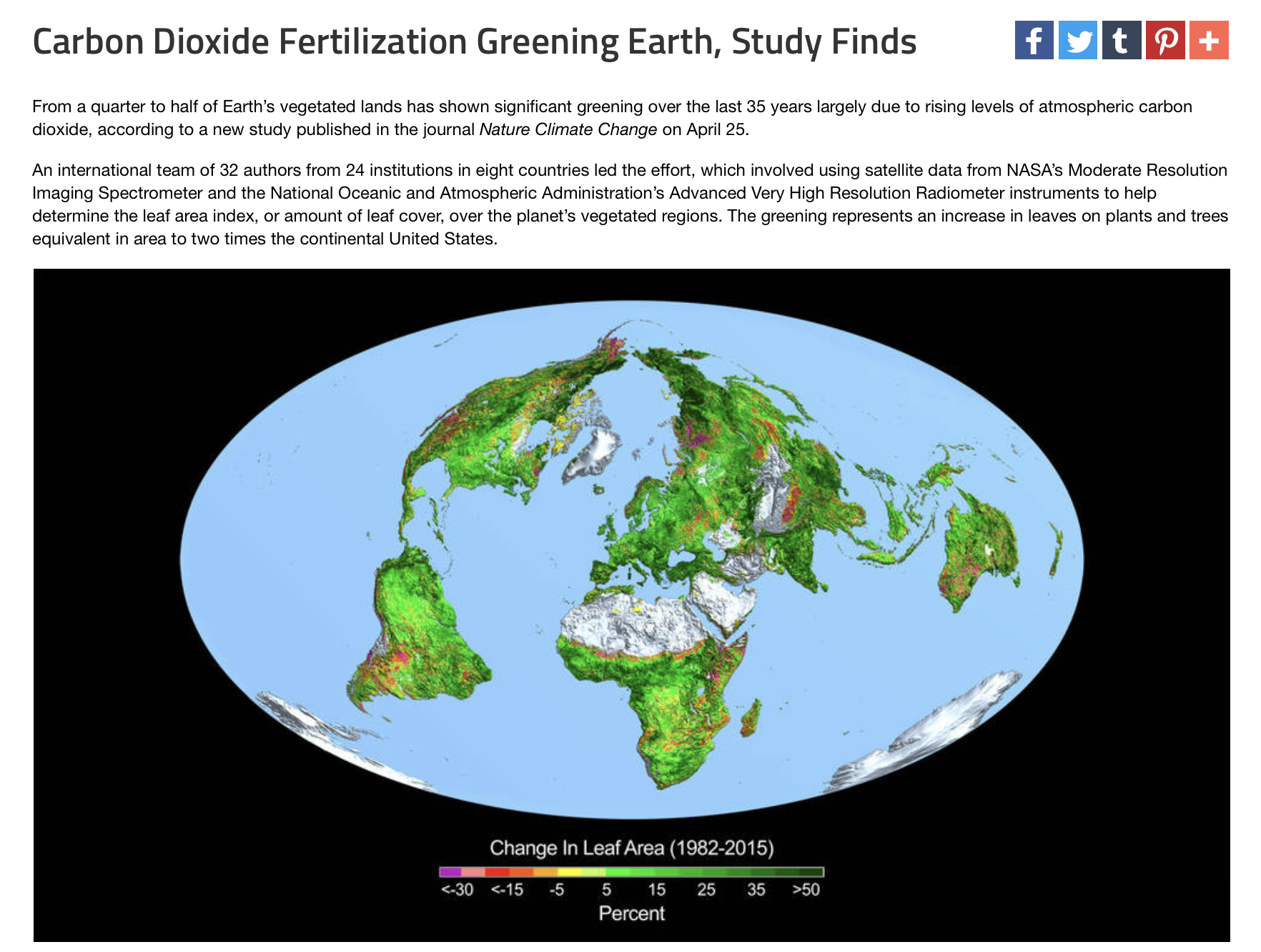
A further glaring omission from this Item 21 is the assumption that CO2 is dangerous green-house gas when in fact it is the stuff of leaf-growth and hence our food supply as proven by NASA satellite surveillance summarised in the following graph:
We also have local DCC confirmation of this wonderful increase in plant growth by way of significant increases in our vegetation control contracts costs due to greater growth in recent years. The extra CO2 we have been releasing into back into the atmosphere from fossil fuels now gives us the potential to properly feed many more people.
This proven CO2 positive should also be part of Item 21 significant assumptions, for balance if nothing else.
The unspoken, uncommitted to writing fundamental assumption that ‘CO2 increase = world temperature increase’ should be clearly stated as an assumption along with evidence, as it is necessary for other assumed claims regarding what can be done by us to lessen climate change impacts.
Looking forward to any alternative data or evidence that can justify the very important assumptions in item 21 that are simply assumed.
Cheers,
Lee
From: Lynne Adamson <Lynne.Adamson@dcc.govt.nz> Date: Wednesday, 20 September 2023 at 6:28 PM To: Council 2022-2025 (Elected Members) <council.2022-2025@dcc.govt.nz>, Executive Leadership Team (ELT) <elt@dcc.govt.nz> Subject: Council Agenda
Kia ora
The agenda for the Council meeting to be held on Monday 25 September 2023 has been published to the Council website and is available on the following links:
Check out this up-to-date big peer-reviewed mRNA data ex Israel.
As well as the widely coerced mRNA vaccines having serious side-effects including death from myocarditis, it has now been proven that Natural Immunity has been far better than any mRNA vaccine.
Posted inUncategorized|Comments Off on Natural Immunity far more effective against Covid

 Point of Order2023 campaign spending per vote
 poonzteam5443March 22 David Farrar writes – The Electoral Commission has published the expense returns for political parties for the 2023 election. I’ve put them in a table with how many votes a party got so we can see the spend per vote.