Mouthing Maori, money and Monet

Tēnā Koe CEO Graham,

Please accept this letter as a formal complaint against Cr Lee Vandervis under the Dunedin City Council Code of Conduct. The Councillor’s emailed letter, (dated Thursday, 12 /10 / 2023, attached below, Page 4-4, labelled Email Message 1) responded to an emailed message from Ms Nicola Morand, Manahautū – General Manager Māori, Partnerships & Policy (Acting) advising all members of Te Pae Māori as to the agenda for our Monday October 17th meeting being held at Ōtākou Marae.

The Councillor’s le

Subject: Te Pae Māori Agenda

Dear All,

I note a Te Pae Maori agenda under our DCC letterhead that does not conform to a normal DCC decision-making agenda as I believe is required under the Local Government Official Information and Meetings Act 1987, particularly Part 7 Local Authority Meetings.

The 3 items on this proposed agenda are devoid of any information, background, discussion, reports, or recommendations, and appear to be non-public without non-public specification.

As such I do not believe that any decisions made under such an agenda can be valid or binding. Please accept my apology for this meeting.
Kind regards,

Cr. Lee Vandervis

Date: Sunday, 17 October 2023 at 10:05 PM

From: Lee Vandervis lee.vandervis@dcc.govt.nz
To: Sandy Graham Sandy.Graham@dcc.govt.nz
Cc: Sophie Barker sophie.barker@dcc.govt.nz Council 2022-2025 (Elected Members); Jeanette Wikaira

Dear Sandy,

I object to the Te Pae Maori Council agenda presentation lack of translations [again], the compliance requirements for entering this Council Hui meeting at Karitane, the co-governance and leadership references in the Principles that we are invited to agree to, and the no-option presumptive wording in the Maori Ward document that reads “

i) Agrees to a decision to establish a Māori ward prior to November 23, 2023,” when it should read i) Agrees to a decision to establish a Māori ward or not prior to November 23, 2023.

Words that must be translated into English in order for non-Maori speakers to be able to comprehend this future-repercussions Principles document include:

Te Pae Māori

Kāti Puketeraki ki Huirapa Rūnaka

Te Rūnanga o Ōtākou

Mataakwaka

TIMATANGA

WHAKAWHANAUKATAKA

Puketeraki ki Huirapa

TRONT

Manatu Whakaaetaka

mana to mana

whakapapa

Tapu and Noa

Tikaka and kawa

Regarding Karitane admission requirements detailed verbally at last week’s non-public meeting, I am not prepared to submit to the sexist, racist and tribal ritual requirements that have been spelled out in order for me to be able to enter “safely” on this marae.

I am a long-term hi-polling elected representative of all the people of Dunedin and I am not prepared to be dictated to in an official Council meeting by an elite claiming to represent 0.67 % of our voting public as detailed in the ward document.

The invitation to confirm co-governance status on this same elite, referred to in the document “Co-design, co-management,” is undemocratic on (sic) my view.

4

The suggestion that this voting minority’s representatives is confirmed by Council as having the primary “Key Direction –

Māori are leaders in the management of our natural resources and built environment” again supplants Democratic fundamentals and there is no surviving ‘Maori built environment’ for Maori to be leaders in the management of.

In summary, this decision-making hui agenda is not understandable by non-Maori speakers, is being held in a Tribal environment that excludes sovereign non-compliant elected representatives, is anti-Democratic and has a presumptive option to “i) Agrees to a decision to establish a Māori ward prior to November 23, 2023”

Until an understandable agenda is supplied with acceptable attendance criteria, I am not prepared to attend what I see as an inscutable (sic) further extension of the Maori MOU that I voted against as undemocratic at the beginning of this triennium.

Regards,
Cr. Lee Vandervis
EMAIL MESSAGE 2 ENDS

5

EMAIL MESSAGE 3 BEGINS

DATE, TIME: TO
FROM SUBJECT LINE:
Dear Cam,

3/08/2023, 11:17 AM
Cam McCracken
cam.mccracken@dcc.govt.nz, Director DPAG Toitū Lan Yuan & Olveston Lee Vandervis <lee@vandervision.co.nz>
Inappropriate Maorification of one of our gallery’s most significant artworks

6

As head of our Dunedin Public Art Gallery, I am disappointed to have to ask you to remove the irrelevant Maorified text by Bridget Reweti pictured below beside one of our Gallery’s most significant artworks, Claude Monet’s ‘La Debacle’.

Even more disappointing has been to learn that you have chosen to ignore a similar request from a member of the public over a month ago.

Monet’s famous ‘La Debacle’ painting has no relevance or connection to: Te Tiriti o Waitangi, the Native Land Court, demolishing Maori social systems, or the MP of the time who claimed “we could not devise a more ingenious method of destroying the whole of the Maori race than by these land courts. The natives came from the villages in the interior and have to hang about for months in our centres of population… the result is that a greater number contract our diseases and die.”

Please remove this text promptly and replace it with relevant text commentary/explanation such as this interesting example which first popped up in my internet search of Monet’s famous painting;

*Title: The Break-up of the Ice (La Débâcle or Les Glaçons)

  • *  Creator: Claude Monet <https://protectau.mimecast.com/s/PLqrC91Znmiz8ApVco4FGL?domain=artsandculture.google.com&gt;
  • *  Date Created: 1880
  • *  Location: Vétheuil and Paris,France
  • *  Physical Dimensions: w99.9 x h60.3 (work)
  • *  Label Copy: The winter of 1879 – 80 was one of Europe’s coldest on record and Monet, who was living in the small town of Vétheuil, witnessed first hand the devastation when the frozen Seine river thawed, dislodging large ice floes that inundated the countryside and damaged bridges. In this painting, Monet explores two contrasting aspects of painting: spatial recession and surface patterning. As the Seine recedes at the left, Monet’s vertical reflections and horizontal floes superimpose a painterly grid that brings the eye constantly back to the surface of the canvas. The exploration of this tension between depth and surface was one of the defining concerns of his career. This debacle of the Seine was the subject of about twenty paintings that Monet worked on into the early spring of 1880. These paintings of ice floes chart Monet’s early fascination with capturing the same motif under differing conditions of light and at different times of day. They were produced over a period of months, while Monet’s later series such as those of haystacks, poplar trees, and Rouen cathedral, were extended investigations of the ephemeral effects of light on a motif during ever-narrower time frames some as brief as fifteen minutes in duration. [cid:image001.jpg@01D9C5FB.E145EE20] Looking forward to your prompt removal of this Maorified irrelevance and replacement with text relevant to one of our Gallery’s most significant artworks. Regards,
    Cr Lee Vandervis
    EMAIL MESSAGE 3 ENDS

EMAIL MESSAGE 4 BEGINS

SENT: WEDNESDAY, OCTOBER 4, 2023 6:11:06 PM
From:
Lee Vandervis <lee@vandervision.co.nz>
To: Bill Acklin <Bill.Acklin@dcc.govt.nz>; Council 2022-2025 (Elected Members) <council.2022-2025@dcc.govt.nz>; Sandy Graham <Sandy.Graham@dcc.govt.nz>
Cc: Ken Tipene <Ken.Tipene@dcc.govt.nz>; Jeanette Wikaira <Jeanette.Wikaira@dcc.govt.nz>; Robert West <Robert.West@dcc.govt.nz>; Sharon Bodeker Sharon.Bodeker@dcc.govt.nz
Subject: Re: Waiata prep for Te Pae Maori [- cultural appropriation added by Councillor Vandervis]

Hi Bill,

You say in your email below that “ it is only right that we are able to deliver Waiata…in a formal environment to the best of our ability.”
I disagree.
I believe that it should be optional for elected representatives to sing Amazing Grace, Waiata, The Internationale or any other song as each elected representative sees fit.

I also think learning Te Reo or NZ sign language should be optional, and that all our decision-making should be in plain English, or with proximate English translation, so that everybody knows what ‘other language’ agenda words actually mean.
I reject your claim that it is ‘only right’ to expect elected representatives to sing at all, leave alone in a language that most of us know little of the meaning of.

I am happy for other Councillors to spend our time singing even though I see it as a waste of time, but I am not prepared to submit to what I consider to be cultural appropriation and being expected to go to Waiata School.

Kind regards,

Lee

EMAIL MESSAGE 4 ENDS

7

Posted in Uncategorized | 4 Comments

Tribalism unmasked and explained

https://www.bassettbrashandhide.com/post/lord-hannan-equality-the-treaty-and-imported-problems

Posted in Uncategorized | Comments Off on Tribalism unmasked and explained

DCC CEO Graham sought legal process opinion as follows:

 28 November 2023 Dunedin City Council  Chief Executive Officer/Tumu Whakarae  Sandy Graham  Sandy.Graham@dcc.govt.nz 

 Dear Sandy 

Notice of motion 

1 You have requested legal advice on the notice of motion promoted by Councillor Laufiso, dated 20 November 2023. In particular you have asked whether procedurally this can be considered by Council at its meeting on 28 November 2023. 

Legal advice 

2 It is our assessment that the notice of motion is now properly included on the agenda. It is the role of Elected Members to consider and vote on the merits of it at their meeting. 

3 This is because it is the role of the Mayor to supervise the procedure and decide whether to direct to refuse any proposed notices of motion from being included in the Council agenda. This proposed motion has not been refused by the Mayor following discussion of it and advice from the Chief Executive. It is now for Elected Members to consider this motion and make a decision on it. 

Reasons 

4 A notice of motion is a means by which any Elected Member can have a proposed motion included on Council’s agenda. This is addressed under clause 26.1 of the Dunedin City Council Standing Orders. This requires notice of an intended motion to be in writing, signed by the mover, stating the meeting at which it is intended to be considered and delivered to the Chief Executive at least five clear working days before that meeting. Having reviewed the notice by Councillor Laufiso, we consider that it satisfies these procedural requirements. We note it was accepted by you as Chief Executive and was considered to comply with this procedure. 

5 There is a discretion in clause 26.2 of the Standing Orders for the Chairperson (here the Mayor) to direct the Chief Executive to refuse to include a proposed notice of motion on the agenda. Clause 26.2 sets out criteria which may justify the Chairperson to refuse any notice of motion in their discretion. 

6 We note from your instructions that upon receiving the notice of motion you took advice on it from the Governance team, then advised the Mayor. The Mayor has not made any direction to you as Chief Executive to refuse to accept the notice of motion. This means that the proposed motion has not been refused and has rightly been included on the agenda for Elected Members to consider and vote on. 

7 It is clear that this proposed notice of motion is a matter of high political interest at the present time. In this context of a proposed motion on a political topic, we are satisfied that the Mayor having not refused the motion has made a decision reasonably available to him. 

8 We have ourselves now assessed the grounds in clause 26.2 of the Standing Orders. We note that it is the exclusive role of the Mayor to form a judgement about whether any of these criteria are met to inform the exercise of the Mayor’s discretion. The context of that evaluation here is that this matter is of high political interest with limited alternative options, and limited implications (if any) for Council workload or budgets. 

9 We comment below on the more relevant grounds in clause 26.2. We are satisfied that the notice of motion does not obviously contravene any of the criteria that ought to justify the Chairperson to refuse the notice of motion for procedural reasons. In particular:  10 It is for Elected Members to evaluate as part of their decision whether they have a sense of the views of persons likely to be affected or have an interest in the matter. It is for the Mayor to exercise a discretion to control the procedure about whether a notice of motion such as this goes on the Council agenda. Having not directed the Chief Executive to refuse this notice of motion, we consider it has now passed this procedural point and it is for the Elected Members collectively to consider the notice of motion, debate it, and vote on it as proposed.    Yours faithfully nderson Lloyd 
Michael Garbett  Partner 
d +64 3 467 7173  m +64 27 668 9752  e michael.garbett@al.nz 
Posted in Uncategorized | 1 Comment

Virtue-signalling focus on just one Israel/Palestine/Hamas of the many overseas Countries’ wars raging round the world currently; Sudan, South Sudan, Somalia, Russia/Ukraine.

It appears that Mayor Radich has approved the addition of the Palestinian flag Notice of Motion being added to tomorrow’s DCC full Council agenda, and is too busy in China Sister City sight-seeing to respond to my email as below, leaving Deputy Mayor Lucas to deal with the fall-out.

The subsequent dropping of the inflammatory ‘fly the Palestinian flag from Mayor’s balcony and other City buildings’ motion in favour of NZ flag at half-mast helped defuse this waste of local government focus and time.

From: Lee Vandervis lee@vandervision.co.nz

Date: Sunday, 26 November 2023 at 11:30 PM

To: Mayor mayor@dcc.govt.nz, Council 2022-2025 (Elected Members) council.2022-2025@dcc.govt.nz, Sandy Graham Sandy.Graham@dcc.govt.nz, Robert West Robert.West@dcc.govt.nz

Subject: Palestinian flag-raising notice of motion

Dear Mr Mayor,

Re Cr. Laufiso’s Notice of motion part 2 calling for agreement “to the City’s flying of the Palestinian flag on November 29th on the Mayor’s balcony and other city buildings, the UN Day of Solidarity with the Palestinian People, as a tangible and visible symbol of support to our local Palestinian community.”

I believe you should refuse this notice of motion as Chairperson of Tuesday’s meeting under Standing Orders Section 26.2:

“(a) is disrespectful …“ [and indeed abhorrent] to a sizeable proportion of our Dunedin community.

and “(b) is not related to the role or functions of the local authority or the meeting concerned;”

The role of the DCC is not to purchase flags to fly from city buildings and the Mayor’s balcony to show solidarity for just one side of an international conflict.

[I note that Cr. Laufiso is as publicly avowed communist who, if this transgression of Standing Orders is allowed, would then also be able to call for the flying of the Russian flag from your balcony and city buildings in solidarity with the military invaders of Ukraine.]

and “(e) fails to satisfy sufficient information as to satisfy the decision-making provisions of s.77-82 LGA 2002;

Cr. Laufiso’s notice of motion fails to provide any information, leave alone sufficient information to satisfy any elected representatives’ decision to show solidarity with just one side of the Israel/Palestinian/Hamas conflict.

Your powers as Chairperson of this meeting are sufficient on any of the counts (a), (b), and (e) of DCC Standing Orders above to simply refuse the entire notice of motion in my view, and I intend to propose that this be done upon the confirmation of the agenda, if you do not use your Chairperson’s authority to refuse the notice of motion prior to Tuesday’s meeting.

I believe that in this way we can maintain an orderly and relevant meeting without having to consider a disrespectful ‘solidarity’ motion with one particular side of an international conflict that lacks sufficient information, and is outside of our functions as a NZ local government Council.

Kind regards,

Cr. Lee Vandervis

Posted in Uncategorized | 1 Comment

Some of my reasons for voting against further lowering of the voting age to 16 in Local Body Elections:

[this from the Guardian newspaper]

This is the new Act:

Electoral (Lowering Voting Age for Local Elections and Polls) Legislation Bill

General policy statement

The Electoral (Lowering Voting Age for Local Elections and Polls) Legislation Bill (the Bill) is an omnibus Bill introduced under Standing Order 267(1)(a). That Standing Order provides that an omnibus Bill to amend more than 1 Act may be introduced if the amendments deal with an interrelated topic that can be regarded as implementing a single broad policy. The single broad policy implemented by the amendments in this Bill is to reduce the voting age in local elections and polls from 18 to 16 years of age.

The Bill amends the Local Electoral Act 2001 so that persons aged 16 or 17 years are eligible to vote in local elections and polls; it does not change the voting age for parliamentary elections. The Bill establishes a new category of electors, named youth electors, and provides for 16-year-olds and 17-year-olds to be registered on a youth electoral roll.

However, although it lowers the voting age to 16 years for local elections and polls, the Bill does not change the age for—

·         being elected or appointed as a member of an alcohol licensing trust or trustee of a community trust:

·         voting in the election of members of an alcohol licensing trust:

·         voting in the election of trustees of a community trust:

·         serving as a juror.

The relevant age for those activities remains 18 years.

from Wikipedia:

“In New Zealand a person is considered a child or “minor” until the age of 20. On reaching this “age of majority” the person is no longer a child in the eyes of the law, and has all the rights and obligations of an adult.[2] There are laws to protect young people from harm that they may be subject to due to their lack of maturity. Some legal age restrictions are lifted below the age of majority, trusting that a child of a certain age is equipped to deal with the potential harm.[3]For example, 16-year-olds may leave school, and 18-year-olds may buy alcohol.”

…and of course vote at 18 with the NZ voting age having been progressively reduced from 21 over the last few decades.

I am old enough to have seen our 8 children grow up and become variously politically aware, and my experience of this combined with information as above strongly suggests to me that voting by most teenagers is unlikely to be well-informed and that younger people are more likely to vote responding to media or peer pressure, not having had enough years/experience to work out what government is about and what is in in societies’ best interests.
There are exceptions of course, but voting age Laws have.to draw a line somewhere.


Posted in Uncategorized | Comments Off on Some of my reasons for voting against further lowering of the voting age to 16 in Local Body Elections:

No elected representative or DCC staff member has responded to any of the information sent to them last week as below:

From: Lee Vandervis <lee@vandervision.co.nz>
Date: Thursday, 21 September 2023 at 10:33 PM
To: Lynne Adamson <Lynne.Adamson@dcc.govt.nz>, Council 2022-2025 (Elected Members) <council.2022-2025@dcc.govt.nz>, Sandy Graham <Sandy.Graham@dcc.govt.nz>, Executive Leadership Team (ELT) <elt@dcc.govt.nz>, Robert West <Robert.West@dcc.govt.nz>
Subject: Re: Council Agenda

Dear All,

Item 21. Climate change significant forecasting assumptions – 10 year plan 2024-34 has included many forecasting assumptions, but fails to identify the most fundamental and important assumptions in my view.
These assumptions resulting in expensive climate mitigation strategies have significant cost implications for our Council Controlled Companies and our ratepayers.

Throughout, emissions are loosely assumed to be CO2, when in fact N2 and  H2O are a much greater percentage component of vehicle emissions than CO2.

Throughout it is also assumed that CO2 is a greenhouse gas, higher levels of which cause global warming.
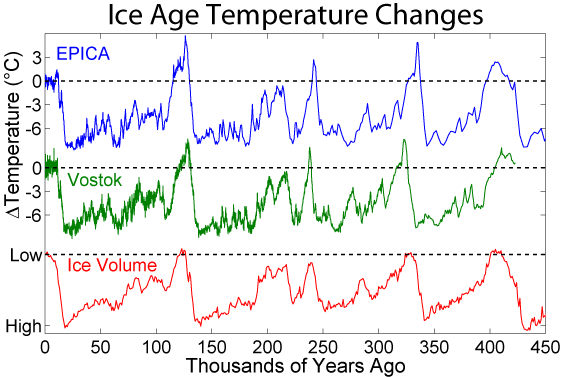
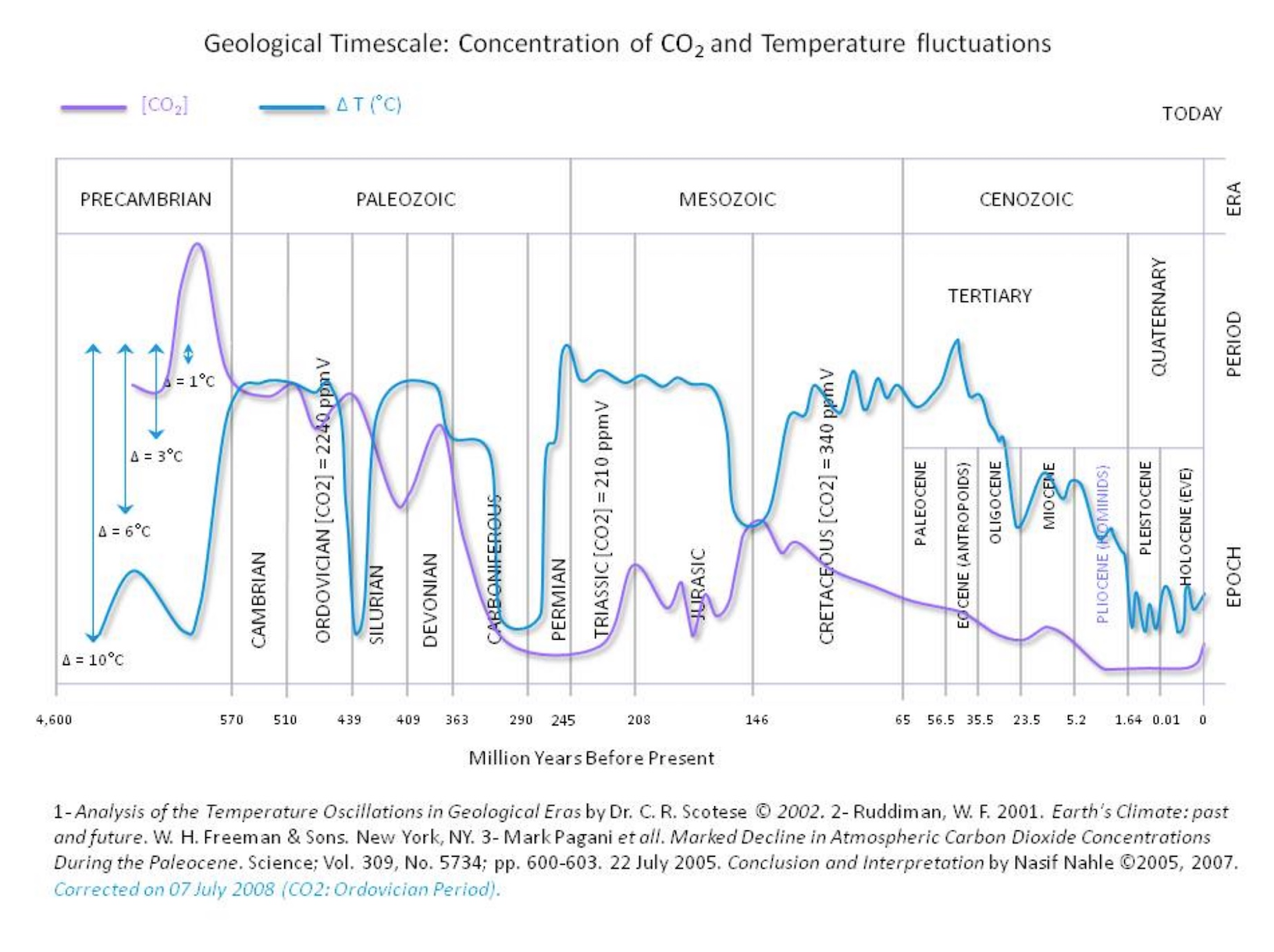
No long term evidence has been available to me to prove this causality, and all the verifiable evidence I have found shows that increasing CO2 levels can not be causal of increasing world temperature, because historically there have been long periods when CO2 was high and temperature low, and other times vice versa,  as the following graph shows.

There has never been a causal connection between CO2 levels and world temperature levels in the past, so why would CO2 suddenly be causal now, just because we are releasing previously sequestered CO2 from fossil fuels back into the atmosphere?
If there is any better or alternative long-term CO2/Temperature evidence available, please let us see it to justify this most fundamental assumption.

Another assumption in this Item 21 is that increasing CO2 levels also contributes to more extreme and dangerous weather events, an assumption that is easy to assume without evidence if you follow main-stream-media.
In fact the last 100 years of dangerous weather events has seen a significant reduction in climate catastrophe deaths as the following data shows:

A further glaring omission from this Item 21 is the assumption that CO2 is dangerous green-house gas when in fact it is the stuff of leaf-growth and hence our food supply as proven by NASA satellite surveillance summarised in the following graph:

We also have local DCC confirmation of this wonderful increase in plant growth by way of significant increases in our vegetation control contracts costs due to greater growth in recent years.
The extra CO2 we have been releasing into back into the atmosphere from fossil fuels now gives us the potential to properly feed many more people.

This proven CO2 positive should also be part of Item 21 significant assumptions, for balance if nothing else.

The unspoken, uncommitted to writing fundamental assumption that ‘CO2 increase = world temperature increase’ should be clearly stated as an assumption along with evidence, as it is necessary for other assumed claims regarding what can be done by us to lessen climate change impacts.

Looking forward to any alternative data or evidence that can justify the very important assumptions in item 21 that are simply assumed.

Cheers,

Lee

From: Lynne Adamson <Lynne.Adamson@dcc.govt.nz>
Date: Wednesday, 20 September 2023 at 6:28 PM
To: Council 2022-2025 (Elected Members) <council.2022-2025@dcc.govt.nz>, Executive Leadership Team (ELT) <elt@dcc.govt.nz>
Subject: Council Agenda

Kia ora

The agenda for the Council meeting to be held on Monday 25 September 2023 has been published to the Council website and is available on the following links:

https://infocouncil.dunedin.govt.nz/Open/2023/09/CNL_20230925_AGN_2520_AT.PDF – PDF version

https://infocouncil.dunedin.govt.nz/Open/2023/09/CNL_20230925_AGN_2520_AT_WEB.htm – HTML version

Posted in Uncategorized | 8 Comments

Natural Immunity far more effective against Covid

Check out this up-to-date big peer-reviewed mRNA data ex Israel.

As well as the widely coerced mRNA vaccines having serious side-effects including death from myocarditis, it has now been proven that Natural Immunity has been far better than any mRNA vaccine.

Posted in Uncategorized | Comments Off on Natural Immunity far more effective against Covid

Our Prime Minister says “People made their own choices”

https://www.facebook.com/watch?v=1014406279577003

Posted in Uncategorized | Comments Off on Our Prime Minister says “People made their own choices”

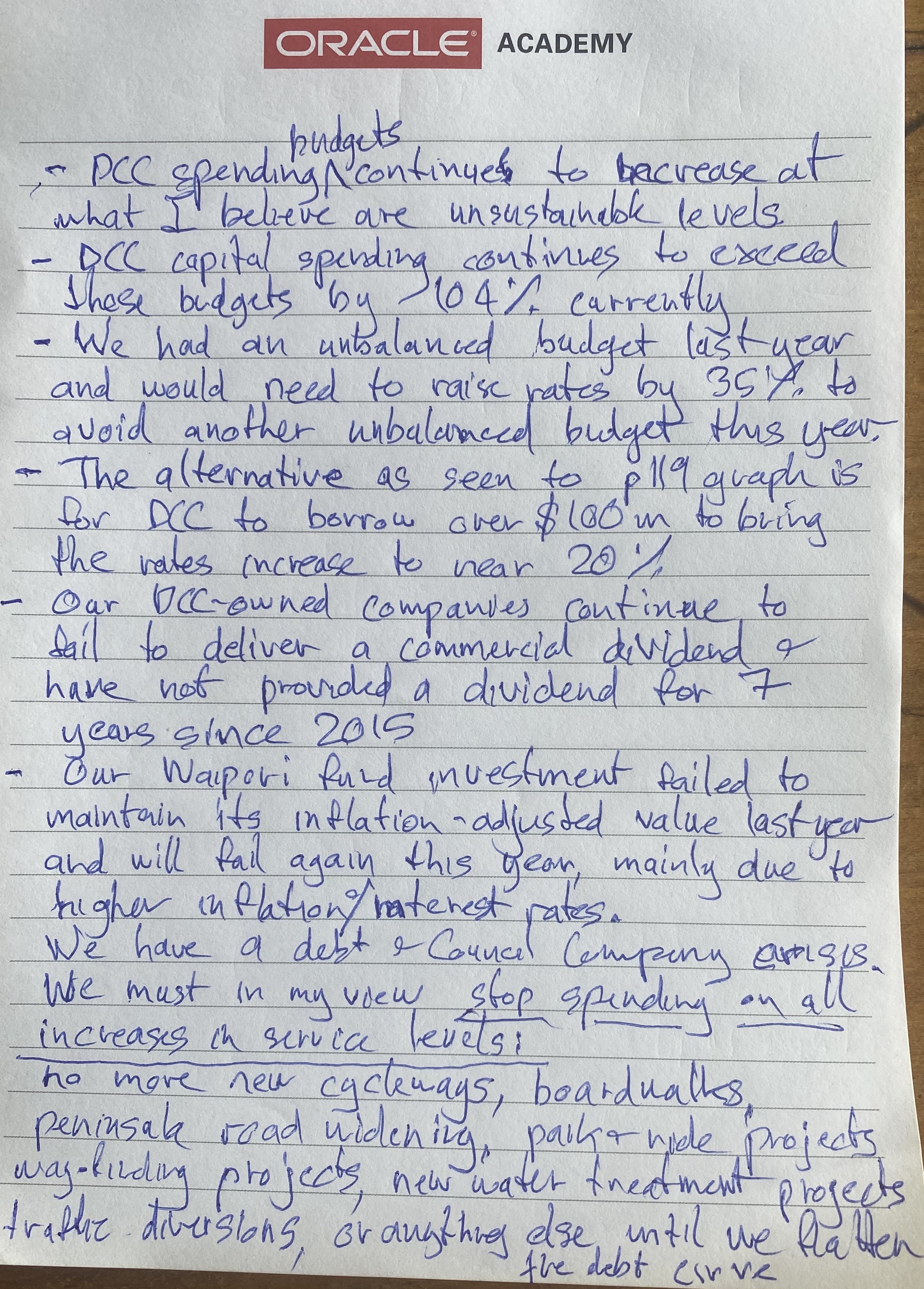
We are paying $1,000,000 per week in interest.

The DCC is now paying an Unsustainable $1,000,000 per week interest on our BILLION$ DCC group debt and nobody even talks about how to pay it back or how we can keep paying the interest!

Posted in Uncategorized | 1 Comment

Is there any Hope for New Zealand?

CHRIS TROTTER: Make or Break

The following post was written in January 2022. What sounded somewhat hysterical just 18 months now sounds utterly plausible.

He Puapua threatens to do to New Zealand’s Right what Rogernomics did to its Left.

IN LESS THAN TWO YEARS the New Zealand Right will face a battle for its very survival. If the combined votes of Labour and the Greens add up to a parliamentary majority in 2023, then the rules of the political game will be changed fundamentally. Capitalism as we have known it, along with our liberal-democratic political system, will be changed profoundly.

The re-foundation of New Zealand (a name which the new Labour-Green government will likely consign to the dustbin of history) will make it virtually impossible for the traditional Right to stage a comeback – at least democratically. Why? Because there will be literally nowhere for the force of a right-wing majority to be brought to bear. The restoration of the status quo ante will, constitutionally, cease to be an option.

Over the top? Don’t you believe it. This is how top-down revolutions work. The first decisive changes are made, and then, if the revolutionary government is re-elected, those changes are embedded beyond the capacity of practical politicians to reverse.

Still don’t believe me? Well then, cast your mind back (or grab a good history book) and review the processes by which the reforms of “Rogernomics” were first implemented and then rendered permanent by the Lange-Palmer-Moore Labour Government of 1984-1990.

More importantly, consider the behaviour of the National Party following the 1990 General Election. In spite of Jim Bolger’s promise to restore the “decent society”, his National Government refused to unwind the economic changes of Roger Douglas and his allies. Indeed, the National Party’s Finance Minister, Ruth Richardson, ably assisted by Jenny Shipley and Bill Birch, turned out to be the one which placed the capstone on the Neoliberal Revolution. By 1993, the social-democratic state erected by the First Labour Government and its successors had been almost entirely dismantled.

Nearly 30 years later, no serious attempt has been made to rebuild it.

This is the key point to take away from the Rogernomics experience. Unless a top-down revolution is stopped in its tracks at the very next election, the chances of rolling it back at some point in the future are reduced to something very close to zero.

Not only will the public servants, business leaders, politicians, academics and journalists controlling the revolutionary process win the time needed to make the necessary legislative changes, but they will also enjoy sufficient time to change the ideological environment in which politics is conducted. By 1990, six years after the neoliberal revolution was unleashed, there simply wasn’t the will in either of the major parties, to launch a counter-revolution. Jim Anderton’s New Labour Party, the only political party unequivocally committed to reversing Rogernomics in 1990, received just 5 per cent of the popular vote.

That’s why 2023 is so important. If the National Party and its ally, Act, are not unequivocally committed to rolling back the ethno-nationalist changes already imposed: the Maori Health Authority; Three Waters; Te Putahitanga; and to repudiating entirely the whole He Puapua blueprint; then by 2026 it is almost certain that neither of the right-wing parliamentary parties will any longer want to. By then, the ethno-nationalist constitution imposed upon “Aotearoa” will be seen by virtually the entire political class as no more than the application of simple “common sense”.

That’s how hegemony works.

Rolling back the He Puapua Revolution will not, however, be easy.

Perhaps the biggest problem confronting the parties of the Right will be a mainstream news media resolutely opposed to giving the ‘hate speech’ of ‘racism’ a platform. Unless National and Act conform to the new ethno-nationalist orthodoxy, they will find it next-to-impossible to secure even-handed media coverage. Rather, they will be presented as fronting a racist, white-supremacist campaign to preserve the ‘privileges’ of ‘colonisation’. Increasingly, the 2023 election will be framed as a life-and-death struggle between the retrograde ideologies of New Zealand’s past, and the Labour-Green promise of a re-founded, te Tiriti-guided, ‘progressive’ Aotearoan future.

The parties of the Left don’t even have to be nasty about it. All they have to do is adapt the crushing line from the movie “Don’t Look Up”. In the movie, whenever a right-wing Boomer makes an unforgivably racist or sexist remark, the stock response from the people in charge is: “He’s from another generation.” Confronted with National’s and Act’s promises to roll back the He Puapua blueprint, Jacinda Ardern and Marama Davidson have only to smile sadly and shrug: “They’re ideas from another generation.”

There’s no worse fate than to be killed with kindness!

The Right is also likely to be hounded by the already shamelessly politicised Human Rights Commission. (Act has, after all, promised to abolish it!) The Commission will call out the parties of the Right for their ‘racism’, ruthlessly and continuously branding their policies as ‘white supremacist’ and ‘colonialist’. With the endorsement of the HRC, other groups will use Labour’s new hate speech law to embroil the right-wing parties and their leaders in court case after court case.

The $64,000 question is not whether these sorts of tactics will lead to polarisation, but exactly where the break in the electorate will occur. If most of those over the age of 50 are driven into the arms of the Right by the He Puapua blueprint then the election will be a damn close-run thing. If, however, it is only a solid majority of the over-60s who opt to stand up for New Zealand (as opposed to Aotearoa) then Labour-Green will likely edge out National-Act. Obviously, effective polling and focus-group work will identify the trends long before Election Day.

Which, inevitably, brings us to the last and most important question: Is the leadership of the National and Act parties capable of withstanding the unrelenting pressure of the ‘racist’ accusation that most New Zealanders currently go to almost any lengths to avoid? Does Christopher Luxon have the mental resilience to confront charges of racism head-on and, Jordan Peterson-style, out-argue his accusers? Does David Seymour? Or will the old saying “explaining is losing” cause them to throw in the ideological towel and join the merry ethno-nationalist parade?

Upon the answer to this question will turn the future of the New Zealand Right. If, as happened to the Labour Party after Jim Anderton and his followers broke away from it in 1989, the new ideology simply swallows up National’s members and parliamentarians, then the He Puapua blueprint will, like Rogernomics, become firmly embedded in New Zealand’s legal and administrative infrastructure. Moreover, it will do so with the same impressive level of cross-party support – quite possibly surpassing the 75 per cent required for major constitutional reforms.

The New Zealand Right thus has no choice but to transform the 2023 General Election into a make or break proposition. If, however, it is electorally broken by its Labour-Green opponents, then politics in Aotearoa-New Zealand will undergo an irreversible sea-change. The constitutional re-foundation of the country suggested in He Puapua will swiftly render the old Left/Right ideological conflicts redundant. By 2026, Aotearoans will be battling politically over very different issues.

Chris Trotter is a political commentator who blogs at bowalleyroad.blogspot.co.nz. This article was re-published at Breaking Views

Posted in Uncategorized | 6 Comments

Dave Witherow used to be the most enlightening columnist the ODT ever published, until he became too enlightening…


https://www.bassettbrashandhide.com/post/dave-witherow-retrospect

Posted in Uncategorized | 4 Comments

Paul Brennan Radio Interview

https://realitycheck.radio/cr-lee-vandervis-on-dunedin-city-councils-debt/

Posted in Uncategorized | Comments Off on Paul Brennan Radio Interview

central government at it again…

Just so that everybody [fluent in te reo and NZ sign language] knows how to drive on NZ roads, we now have bi-lingual road signage being forced upon us.

None of the objections or difficulties I noted as below were included in the DCC submission to government on bi-lingual road signage.

From: Lee Vandervis lee@vandervision.co.nz

Date: Monday, 19 June 2023 at 12:06 PM

To: Simon Drew Simon.Drew@dcc.govt.nz, “Council 2022-2025 (Elected Members)” council.2022-2025@dcc.govt.nz, Sandy Graham Sandy.Graham@dcc.govt.nz

Cc: “Executive Leadership Team (ELT)” elt@dcc.govt.nz, Jeanine Benson Jeanine.Benson@dcc.govt.nz, Gina Huakau Gina.Huakau@dcc.govt.nz

Subject: Re: Council Submissions on He Tohu Huarahi Māori bilingual traffic signs

Hi Simon,

I disagree with the proposed change to bilingual traffic signage and I believe that the vast majority of people I represent also do not want it..

The fundamental purpose of traffic signage is for safety and to direct traffic, often with split-second decision making.

There is already evidence of signage overkill, strict nzta rules around letter sizes/competing signage/etc., and signage confusion causing accidents and death, because of legibility issues especially in bad weather.

Bi-lingual signage will only make these already recognised problems much worse.

The claim that “Bilingual signs will help ensure there are everyday opportunities for all New Zealanders to engage with and use te reo Māori.“

is ridiculous as there are already panoramic opportunities to engage with and use re reo Maori if people want to.

Reading traffic directions is not an opportunity to engage in alternative language learning.

Such a major proposed change to bi-lingual signage should be preceded by a central government referendum on the issue.

The cost of such change even when staged will be considerable in terms of dollars, but the really terrible cost will be in injuries and lives lost through confusion, especially for the millions of tourists that use our already dangerous roads.

Regards,

Lee

Posted in Uncategorized | 1 Comment

Car-cancelling Council shagging Dunedin Future Transport

Hawkin’s Council hangover continues with another $146,000,000+ extra debt this year, much of it funding ‘Shaping Dunedin Future Transport’, which I see as shagging Dunedin Future Transport, driving cars out of our city, slowing traffic and making parking even more difficult.

I have often been alone in voting against $100,000,000 of recent planet-saving transport changes including: $28 million used to slow George st traffic to a one-way crawl, the $16 million being spent to send One-Way system traffic [also to be slowed] to the far side of our Railway Station, the $9 million proposed to fund ‘way-finding apps and signage’ to direct people to increasingly scarce parking rather than provide parking, the budgeted $10 million ‘park and ride’ carparks at Mosgiel and Burnside where motorists will be ‘encouraged’ to park and then bus into the City Centre, another $30 million on more cycleways that remain grossly underused, and $20 million for ‘surface treatments’ down Princes street where carparks will be lost to a ‘priority bus lane’… 

The ODT reported some of the debate, but missed the real $100,000,000 borrowed and wasted transport spend issue:

May 20 2023, Otago Daily Times

My debate speech video:

https://www.youtube.com/watch?v=cxjnQ12Kw9g&t=4550s

Posted in Uncategorized | Comments Off on Car-cancelling Council shagging Dunedin Future Transport

We have long been falling behind other NZ Cities

Dunedin is over-reliant on Central Government funded institutions like the Hospital and the University.

Especially as Government funding tends to go to marginal Parliamentary seats up north…

Posted in Uncategorized | Comments Off on We have long been falling behind other NZ Cities

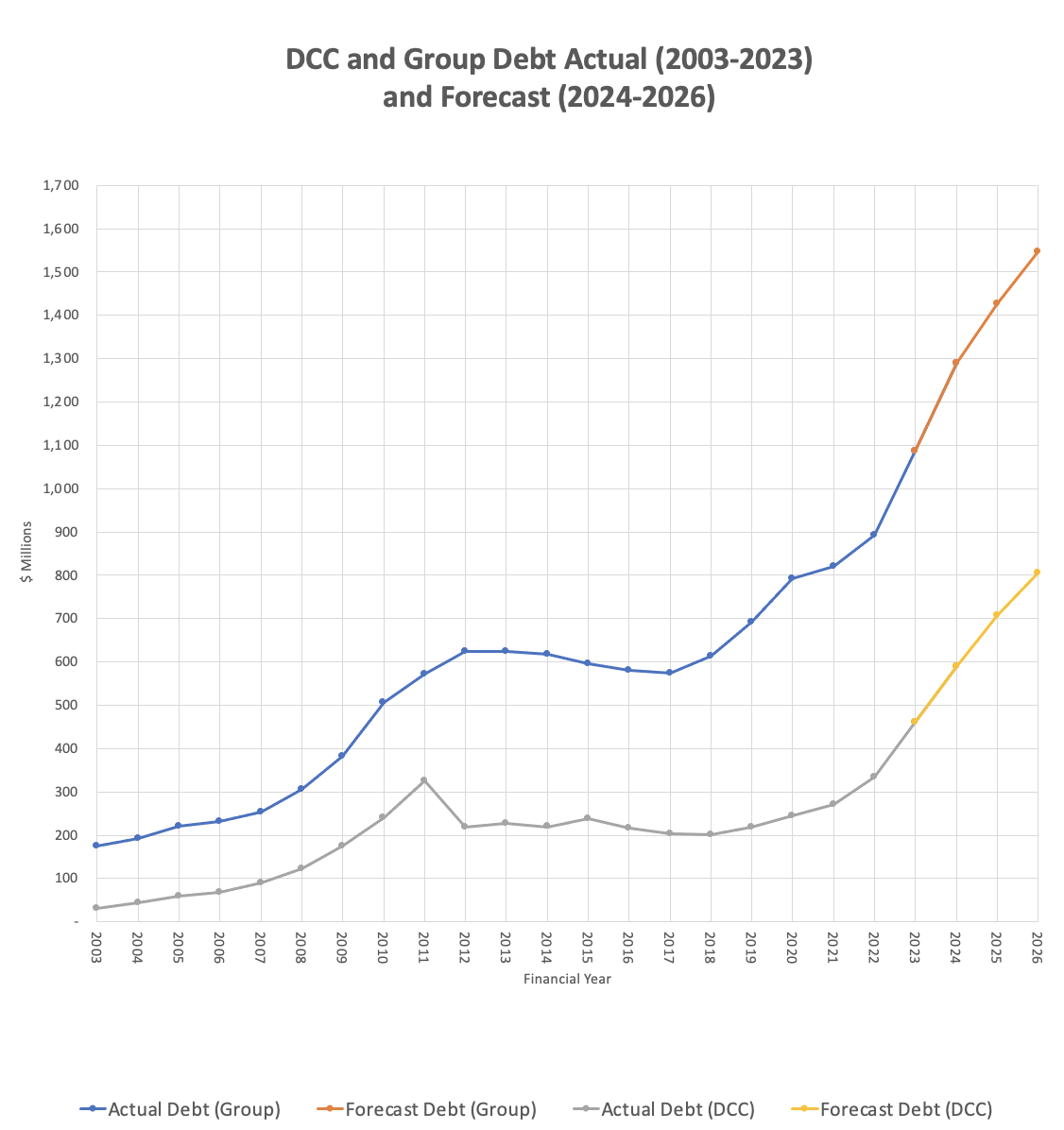
the latest DCC Debt Graph

Posted in Uncategorized | Comments Off on the latest DCC Debt Graph

DCC Debt Graph and budgeted projection 10 years ago

See next post above for what has actually happened after the big Stadium debt blow-out, in the latest DCC debt graph.

Posted in Uncategorized | 1 Comment

ANZAC DAY Speech Brighton Town Hall 25.04/23

War – what it is good for? – absolutely nothin’.

So sang Edwin Starr in the 1970s #1 hit single which added to pressure on the US Government to withdraw its forces from Vietnam.

But the simple appeal of the idea that War is ‘good for nothing’ really is simplistic.

As Jimi Hendrix said “Of course war is horrible, but at present it’s still the only guarantee of peace.

That present has moved on with a rapid decline in war deaths since 1945, but as the conflict in Ukraine shows, War remains an ever-present threat…
And the Ukraine War is not just a War in Ukraine but a Civil War of the West with terrifying possible consequences for all of us.

I am not so sure that War can guarantee Peace, but many who have fought in Wars that we now commemorate did so with that belief.


Technology has moved on too, so that now War is far more deadly, more visible, and more focused than ever before.

War is obviously good for arms manufactures, for technological development, and often for boosting an economy.
Henry Ford made millions supplying truck engines to both sides, the Allies and the Germans in WW2, and he was one of many that profited greatly from War.
There are always some big winners in War, but most of us are losers.

We are here today to commemorate those that lost their lives, their healthy bodies, and sometimes their healthy minds to the horrors of War in defence of our peace and our freedoms. 

My first of 3 recommended books today is #1 Van der Kolk’s ‘The Body Keeps the Score’.
Van der Kolk is a professor of psychiatry at the Boston University of Medicine and his insightful book gives telling testimony of Vietnam War veterans’ traumatic experiences and how mentally damaged some are as a result of horrific War experiences.

The old saying ‘Whatever doesn’t kill you makes you stronger’ is obviously untrue as psychiatry begins to unpack post-traumatic-stress-disorder and other by-products of War.


We should ask ourselves to consider how attitudes to War have changed, and use ANZAC DAY to reflect on War and what We can learn from past conflicts.


My personal view of War has been very much shaped by my Grandfathers’ War experiences in Holland, and my Father’s experiences in Indonesia – Holland’s version of Vietnam after WW2.


My paternal Grandfather was a wealthy building contractor before WW2 and had 4 spec houses on the go when War broke out, but he only managed to sell one of them.
His reaction to the outbreak was to buy a whole trailer-load of Havana cigars as he was ‘not going to sit through another War without his favourite cigars’.
The War, loss of fortune, and privation made him so miserable however that hardly smoked any of them and in the third bitter Dutch winter of the War he traded the whole trailer-load of cigars on the black-market for a pan of fat.


He had to hide my then 16 year-old Father from the Germans who would have conscripted him for the army or munitions manufacture, as they did with most able Dutch males. The well-disciplined occupying Germans generally left the females alone.
They used to do occasional dawn raids on homes and rush into bedrooms to check how many beds were warm, and how many females there were in the house. If there was an extra warm bed they would tear the house apart to find the hidden male. I have wondered what effect years of sleeping in one of his sisters’ beds would have had on my pubescent teenage Father. Perhaps that explained why he never talked about sex.

I was named after my maternal Grandfather Lieuwe Bylsma, who was a conscientious objector in WW1.

He refused to kill anybody, and was consequently sent to the front line trenches where he was forced to peel potatoes with bullets and shells blasting all around him. Miraculously he survived.  

The best book I have read describing the horrors of WW1 trench warfare is # ‘All Quiet on the Western Front’ by Erich Remarque. The movie doesn’t do the book justice unsurprisingly.
By the time of WW2 my maternal Grandfather had a transport business and had taught himself fluent German, so was able to convince the occupiers that he was a Nazi sympathiser and was prepared to distribute hospital supplies for the Germans if they let him keep two of his trucks.


With no petrol available he modified his trucks to run on wood gas and amongst his wide range of contacts he knew a master forger who was not long out of jail. With these resources he was able to steal half of the German medical supplies for his extended Community around Utrecht, as the Germans saw no problem with half-empty trucks as long as the paperwork was perfectly matched.
At night-time he ran a kind of Secret Army using his trucks to ferry Jews and some downed British airmen to the coast to get them safely to England.
It was my teenage mother’s job to flirt with patrolling German soldiers at the front gate of their house so that they would not enter and search for hidden escapees. 
It is hard to imagine the responsibility she bore, knowing that if she did not keep these usually young patrollers diverted and send them on their way that my Grandfather and Uncle Henk were waiting either side of the front door with lead coshes that would see them buried in the back garden that night.  

My point in contrasting my different Grandfathers’ differing War experiences, is that the Financial Capital on my father’s side was of little use in the War, and his being able to buy anything he wanted in Peacetime made for a very miserable hungry War experience.
My Mother’s Father on the other hand, with his range of skills and contacts – his Social Capital, was able not just to survive the War but to be effective in saving lives and keeping his family and Community healthy. 
War brought his Community together, everyone did whatever they could and real Trust in each other was vital to surviving the Occupation.
Uncomfortable memories were likely the reason my Grandfather did not volunteer talking about the War, but when I could wheedle some stories out of him it was obvious that he had reveled in those years of confronting adversity that had brought them all so closely together.
The potential to live an effective and even joyful life whatever the circumstances is forcefully brought home in a wonderful short book called #3 ’Man’s search for Meaning’ by Viktor Frankl, a Jewish psychologist who survived Auschwitz.

The horrors of War cannot be overstated, but the power and riches drivers for making War should also not be underestimated.
‘War is hell’ as US General William Sherman’s said to the graduating class of the Michigan Military Academy in 1879.

The Hellishness of War has not been much of a deterrent for making War since however, and our attitudes to War have varied significantly over time and in different places.


In a more connected world our divisions now seem as deep as ever, and vicious Wars world-wide reflect the petty usually emotional battles we tend to indulge personally with each other.

‘There is nothing worth having that you don’t have to fight for’, but there are many different ways to fight for something, and physical battles are being superseded by emotional and psychological battlefields.
Artificial Intelligence will speed this process so that Wars are now more about ideologies, hearts and minds, rather than land or resources.


We should ask ourselves: ‘What do we really value?
And what are we prepared to do to keep the Peace and to keep what we really value?

What in fact are We good for?

Do Good and Be Good.

 
Thank you for your attention.

Posted in Uncategorized | 1 Comment

Dunedin’s Water distribution systems still being taken by central government and misrepresented despite all objections

60 of 67 Councils voted to opt out of the 3 Waters takeover when this Labour government misled us into thinking we had a choice.

Now 10 regional entities instead of the earlier tribal 4, still with 50% Maori governance, remains the theft of Dunedin ratepayers’ paid-for over 150 years billion$+ investment in our water distribution systems.

“The entities would be owned by councils “ is a much-repeated falsehood.

Ownership is defined as ‘having control over an asset’ and Councils would have no control under the un-elected 50% Maori governance that has been pivotal since MP Mahuta misrepresented it.

Posted in Uncategorized | Comments Off on Dunedin’s Water distribution systems still being taken by central government and misrepresented despite all objections

It is getting harder to ignore media mandates and suppression of dissent

Posted in Uncategorized | 1 Comment