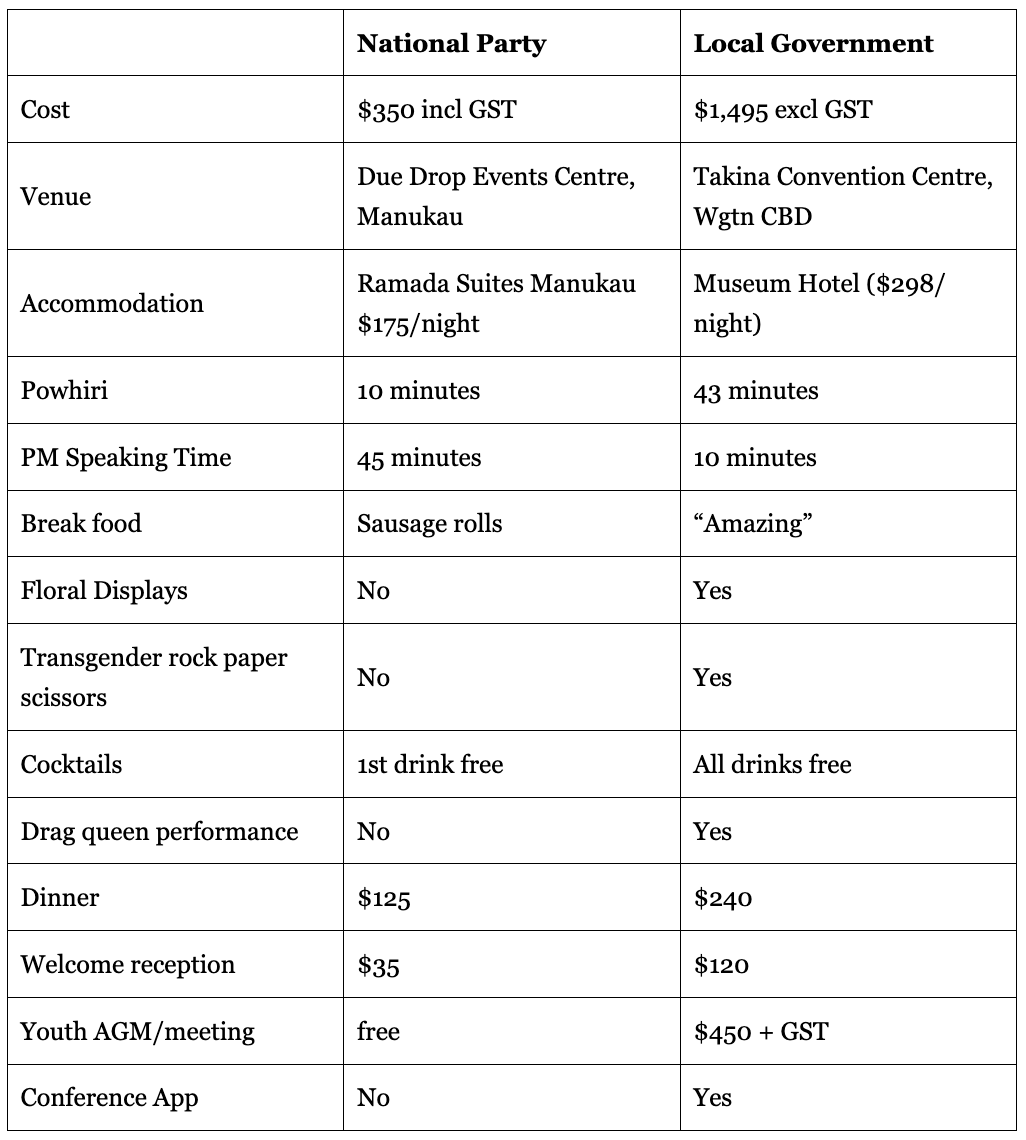
Apparently this Kiwiblog bloke has been able to find the following political costs:
I have been voting to stop DCC funding of self-serving Local Government New Zealand for over a decade and have always refused to go to their conferences. Recently both Auckland and Christchurch have stopped funding LGNZ. Dunedin should do the same. Cr. Michael Laws publicly calls them ‘troughers’ for good reason in my view.
August 28, 2024 3:00pm by David Farrar
A tale of two conferences
A number of readers attended both the recent National Party Annual Conference and the Local Government annual conference. They were struck by the differences between the two. A key factor being that those who attend the National conference pay the cost themselves and those who attend the LG conference have ratepayers pay the cost.
Amazing the difference it makes, depending on who has to pay!
Posted inUncategorized|Comments Off on If things seem strange, check who pays:
The Dunedin City Council have requested I make an apology and much else beyond the powers of the DCC Code of Conduct rules. My response to their over-reach was made public by the DCC today.
From: Lee Vandervis <lee@vandervision.co.nz> Date: Tuesday, 20 August 2024 at 4:18 PM To: Edward Ellison; Andrew Rouvi; Donna Matahaere-Atariki; Rachel Wesley; Caron Ward; David Ellison Megan Potiki;Matapura Ellison – ALT; Emma Wyeth- ExecSuzanne Ellison; Vicky Totoro; Marlene McDonald; [private email addresses removed on request]
Dear Elected and non-Elected members of Te Pae Maori.
I am sorry that some of my statements and actions as an Elected Representative have caused offense to some for which I unreservedly apologise. Causing offense was never my intention.
Following a 4090 word Code of Conduct complaint brought against me by Cr. Laufiso, the investigator’s opinion is that I have breached the DCC Code of Conduct. His reasons given included: my refusal to attend Te Pae Maori Protocols and Waiata singing training, refusal to attend Te Pae meetings at Marae with reasons given, and voicing my opinion that giving unelected Maori elite representatives voting rights on two major DCC Standing Committees was undemocratic.
Elected Council Members of Te Pae Maori have subsequently requested that I: “d) provide a full and unreserved written apology by 5pm
on 20 August, 2024 to the Te Pae membership for the behaviour outlined in the
investigation; and Council also requests that Cr Vandervis makes a commitment to
participate in Te Pae meetings and observe the kawa (protocols) of the host.” This Council resolution further: “e) Notes that if an apology has not been received by 20 August 2024, Council staff
will provide a report to the 27 August Council meeting on the possible options
available to Council for a material breach of the Code of Conduct.”
In the debate leading up to this resolution Crs Garey, Barker, Walker, Benson-Pope, Mayhem, Whiley and O’Malley made it clear that they wanted to penalise me by removing me from the position of Chair of Finance and Council Controlled Organisations. Cr. Benson-Pope had already called for my removal from this Chair over a year earlier on 17/7/23. Cr. O’Malley went further promising that if I was not removed as Chair he would “refuse to attend” any meetings I was Chairing. In the Code of Conduct debate of 31/7/24 it was made clear by many Councillors that I was very unlikely to apologise [Cr. O’Malley “…we will not be receiving an apology”] and Cr. Whiley agreed.
Having tried to coerce me with the threat of loss of my Finance and CCO chairmanship [along with its annual near $14,000 addition to salary] into making what Elected Representatives hoped would be a full, unreserved written apology, they also requested that I make ‘a commitment to participate in Te Pae meetings and observe the kawa (protocols) of the host.” Subsequent Anderson Lloyd legal advice recently sent to all Elected Members is that “We conclude that the second part of the resolution requiring Councillor Vandervis to make a commitment to participate in future meetings and observe kawa or protocols of the host goes beyond the terms of the code of conduct. We conclude this aspect of the resolution is therefore outside Council’s power to require as part of a code of conduct decision.”
The Anderson Lloyd legal advice concludes: “8 It is our view if there is no apology and a future meeting is convened to consider penalties, any
penalty needs to be confined to the options set out in clause 13.1 of the code of conduct. This
does not extend to requiring future commitments to participate in future meetings. We
recommend against such a resolution because it is outside the terms of the code of conduct.”
The NZ Bill of Rights Act provides me with all the defence I need against these Code of Conduct accusations, particularly the sections relating to freedom of speech, movement, expression and religion.
For the Council to attempt to remove me from an appointed Chair position because I won’t alienate those Rights is beyond Council’s powers. I have not contracted out of NZ Bill of Rights freedoms because I have been elected to the DCC. It is because I am elected to represent the best interests of Dunedin citizens that I feel obliged to uphold the provisions of the NZ Bill of Rights, especially Freedom of Expression which should always be available to all Dunedin citizens.
Following the Code of Conduct investigator’s report, the Dunedin City Council has only one of eight penalties available under 13.1 of the Code of Conduct. Elected Representatives have used their one available penalty under 13.1, namely “2. A request (made either privately or publicly) for an apology;” as above, and they have made this request of me publicly along with claims of alleged racism which I reject, and they have caused me reputational harm.
Since Council have already publicly invoked penalty “2. a request (made either privately or publicly) for an apology;” with the negative attendant publicity that I have incurred, I submit that my apology as above now brings to an end the current Code of Conduct process.
Kind regards, Cr. Lee Vandervis
Posted inUncategorized|Comments Off on Latest DCC Code of Conduct claimed against me by Cr. Laufiso.
Moved (Mayor Jules Radich/Cr David Benson-Pope): That the Council: a) Upholds the findings of the investigation by the Independent Investigator, Mr Jordan Boyle into the Code of Conduct complaint made by Cr Marie Laufiso in respect of Cr Lee Vandervis. b) Agrees that a material breach of the Code of Conduct has occurred. c) Notes that Cr Vandervis has declined the opportunity to address the Council.
d) Requests that Cr Vandervis provides a full and unreserved written apology by 5pm on 20 August, 2024 to the Te Pae membership for the behaviour outlined in the investigation; and Council also requests that Cr Vandervis makes a commitment to participate in Te Pae meetings and observe the kawa (protocols) of the host. e) Notes that if an apology has not been received by 20 August 2024, Council staff will provide a report to the 27 August Council meeting on the possible options available to Council for a material breach of the Code of Conduct. Division
The Council voted by division For: Crs Bill Acklin, Sophie Barker, David Benson-Pope, Christine Garey, Kevin Gilbert, Carmen Houlahan, Cherry Lucas, Mandy Mayhem, Jim O’Malley, Steve Walker, Brent Weatherall, Andrew Whiley and Mayor Jules Radich (13). Against: Nil Abstained: Nil The division was declared CARRIED by 13 votes to 0 Motion carried (CNL/2024/001)
Membership of Te Pae Maori:
Edward Ellison;
Andrew Rouvi;
Donna Matahaere-Atariki;
Rachel Wesley;
Caron Ward;
David Ellison
Megan Potiki;
Matapura Ellison – ALT;
Emma Wyeth- Exec
Suzanne Ellison;
Vicky Totoro;
Marlene McDonald;
Tania Williams [email addresses removed following request]
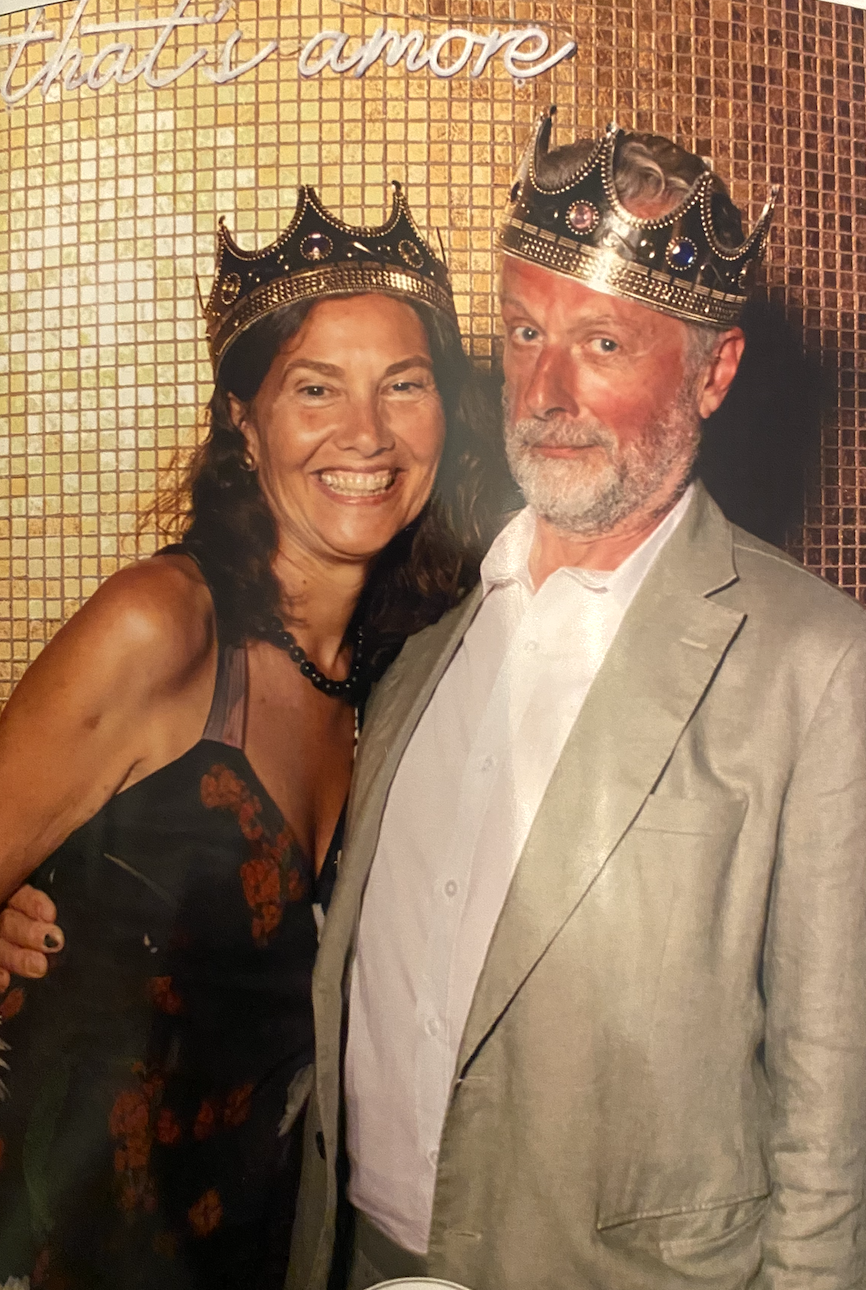
Not looking forward to coming back to Dunedin chill after summer weather overseas.
Our relatives in Germany treated us Royally for my wife’s sister’s Wedding, ceremony and after-match functions.
Who would guess from the photos that I was the only one of 86 wedding guests in Heidelberg who did not partake of the copious and varied supplies of free alcohol?
Posted inUncategorized|Comments Off on Back from warm overseas holiday.
From: Lee Vandervis <lee@vandervision.co.nz> Date: Monday, 29 July 2024 at 7:00 PM To: Council 2022-2025 (Elected Members) <council.2022-2025@dcc.govt.nz> Subject: My Response to CoC from Crs Laufiso and Mayhem
Dear All,
Following requests from Dunedin citizens and media, I have decided to make a short written response to the 4090-word Code of Conduct complaint against me alleging racism from Crs Laufiso and Mayhem. I request that this statement be read out prior to the Council vote on the Conduct debate of 31st July in my absence as I will be attending a family wedding in Heidelberg at the time. I am happy for the Code of Conduct debate to take place in my absence.
Statement to be read out:
“I can not represent Dunedin citizens by singing, pretending to speak a Maori language, or by voting for more race-based funding of Maori elites and jobs. I reject all accusations of racism, especially coming from those who repeatedly label me “pale, stale, and male” across the Council table as this personal abuse really is racist, ageist and sexist. I vow to continue to exercise my Right to Free Speech in the public interest and to be part of the diversity necessary for Democratic representation on the Dunedin City Council.”
Kind regards, Cr. Lee Vandervis
Below is the complete 4090-word Code of Conduct complaint against me from Crs. Laufiso and Mayhem which I made public without comment on my blog leevandervis.com last year.
Please accept this letter as a formal complaint against Cr Lee Vandervis under the Dunedin City Council Code of Conduct. The Councillor’s emailed letter, (dated Thursday, 12 /10 / 2023, attached below, Page 4-4, labelled Email Message 1) responded to an emailed message from Ms Nicola Morand, Manahautū – General Manager Māori, Partnerships & Policy (Acting) advising all members of Te Pae Māori as to the agenda for our Monday October 17th meeting being held at Ōtākou Marae.
The Councillor’s letter is yet another example of his demonstrated contempt for Te Pae Māori specifically and both Mana Whenua and Matāwaka generally. As such, this falls well-short of the standards we should expect of someone, not only of his experience but, who holds such a position of responsibility within Council (as Chair of the Finance & CCOs Committee). As a result of the Councillor’s second piece of correspondence, the Te Pae Māori meeting of 17 / 10 / 2023 – for the second time – passed a resolution to not accept his apology, despite Mayor Radich’s and a number of Councillors’ support of Cr Vandervis. The Councillor’s attempts to diminish and undermine the standing of Mana Whenua, are in breach of the following:
5.1 Relationship between members – avoids aggressive, offensive or abusive conduct, including the use of disrespectful or malicious language
5.3 Relationship with public – act in a way that upholds the reputation of the local authority.
Te Pae Māori exists largely as a forum for any such concerns to be raised kanohi ki te kanohi (face-to-face) and directly with the Mayor and Councillors. Therefore, by refusing to participate in meetings of Te Pae Māori, the Councillor is failing in his duty to “be available to listen and respond openly and honestly to community concerns.”
To avoid at the very least the costs of an investigation and the inevitable emotional toll on Tākata Whenua (Mana Whenua and Matāwaka) Colleagues and Staff Members who are members of Te Pae Māori, SPEC or ISCOM, this deeply disappointing matter ought to have been fully and soundly dealt with by Mayor Radich. However, since the first Te Pae Māori meeting at Puketeraki Marae held on Monday, July 17th, Mayor Radich has been asked multiple times, in writing and in person, to address concerns around the Councillor’s behaviour. The Mayor however has done very little to acknowledge, address or remediate these concerns. Such concerns relate to the Councillor’s long-standing antipathy towards Tākata Whenua ~ stemming from wilful ignorance (at the very least) and at worst, bigoted, intolerant-of-difference and racist beliefs. Examples I have personally witnessed/heard in Council Chambers ) :-
(Every time) Mispronounces the word “Māori”
(Long-term Plan debate, 2018) That Aukaha as a Mana Whenua consultancy should not be granted funding (rate-payers’ money) for consultancy work for the DCC “because they already received extensive Treaty settlement funding.”
(Mana Whenua representatives on two DCC Committees debate, 2021) That such representation by “unelected members” is “undemocratic.” (This ignores the fact that such unelected members chair and/or sit on the DCC’s Audit and Risk Committee.)
(Three Waters debates, 2021, 2022) Questioning Tākata whenua involvement in co-governance arrangements through which boards of water entities would be appointed – “What knowledge of water pipes and infrastructure did Māori have in 1840?”
(Three Waters debates, 2021, 2022) Insistence on referring to the Local Government Minister Nanaia Mahuta as only “Mahuta” or “MP Mahuta” despite points of order (25.2.b use of disrespectful, offensive or malicious language) upheld by Mayor Hawkins. For me, an elected member of seven years underpinned with thirty years’ experience as a co-designer and facilitator of Te Tiriti o Waitangi / Decolonisation workshops, the above are almost “as nothing” – compared to the Councillor’s recent correspondence of 2023. While I initially referred to one piece of correspondence from July, here I cite three more ~ further illustrating, in my view, an enduring pattern of the Councillor’s behaviour.
• The Councillor’s emailed letter, (dated Sunday, 16 /07 / 2023, attached below, Pages 4-5, labelled Email Message 2) sent 12 hours ahead of the first meeting of Te Pae Māori, held at Puketeraki Marae outlined the Councillor’s objections to the agenda and the Te Pae Māori document as reasons why he would not be attending. Further, I highlight “Regarding Karitane admission requirements detailed verbally at last week’s non-public meeting, I am not prepared to submit to the sexist, racist and tribal ritual requirements that have been spelled
1
out in order for me to be able to enter “safely” on this marae. I am a long-term hi-polling elected representative of all the people of Dunedin and I am not prepared to be dictated to in an official Council meeting by an elite claiming to represent 0.6”7 % of our voting public as detailed in the ward document.” The invitation to confirm co-governance status on this same elite, referred to in the document “Co-design, co-management,” is undemocratic on (sic) my view.”
The Councillor’s emailed letter, (dated Thursday, 03 /08 / 2023, attached below, Page 6-6, labelled Email Message 3) expressed disappointment that Cam Director (Director DPAG, Toitū Lan Yuan Olveston) had chosen to ignore a request that the “Maorified (sic) text by Bridget Reweti” below Claude Monet’s “Debacle be removed. “As head of our Dunedin Public Art Gallery, I am disappointed to have to ask you to remove the irrelevant Maorified text by Bridget Reweti pictured below beside one of our Gallery’s most significant artworks, Claude Monet’s ‘La Debacle’. Even more disappointing has been to learn that you have chosen to ignore a similar request from a member of the public over a month ago. Monet’s famous ‘La Debacle’ painting has no relevance or connection to: Te Tiriti o Waitangi, the Native Land Court, demolishing Maori social systems, or the MP of the time who claimed “we could not devise a more ingenious method of destroying the whole of the Maori race than by these land courts. The natives came from the villages in the interior, and have to hang about for months in our centres of population… the result is that a greater number contract our diseases and die. Please remove this text promptly and replace it with relevant text commentary/explanation such as this interesting example which first popped up in my internet search of Monet’s famous painting…”
The Councillor’s emailed letter, (dated Wednesday, 04 /10 /2023, attached below, Page 7-7, labelled Email Message 4) was his response to Councillor Acklin’s invitation to us elected members to prepare a waiata for the pōwhiri process of the up-coming Te Pae Māori hui (October 17th) at Ōtākou Marae. I highlight the following: “I reject your claim that it is ‘only right’ to expect elected representatives to sing at all, leave alone in a language that most of us know little of the meaning of.I am happy for other Councillors to spend our time singing even though I see it as a waste of time, but I am not prepared to submit to what I consider to be cultural appropriation and being expected to go to Waiata School.” Councillor Acklin did respond to this, saying he had anticipated a response such as this from the Councillor. Councillor Acklin was among a number of us who implored Mayor Radich to take steps to curb Councillor Vandervis’ offensive behaviour. For my part, I lodged a Notice of Motion to censure the Councillor [18 / 08 / 2023] in relation to Te Pae Māori, but this was rejected as being out of order. Such an action could only be taken at the conclusion of a formal Code of Conduct process which I am now invoking. Although Your Staff are of course Yours to manage and guide, I as a Governor can no longer stand by, witnessing the Councillor’s ongoing harassment of Your Staff (Tākata whenua and Tauiwi alike) while subjecting them to his persistently racist conduct and imperiously bigoted emails. Nor can I any longer silently abet the Councillor’s years of constantly undermining (covert and overt) the status of Mana Whenua and Matāwaka. In no other similar organisation would such unprofessional and distasteful behaviour be tolerated for as long as the Councillor has been able to conduct himself thus – unchallenged and with impunity. In the wake of the March 15th (2019) terror attacks in which 51 Ōtautahi Christchurch Muslims were murdered and 40 injured, Council adopted a position of “zero tolerance” towards racism. We can no longer let our silence be interpreted as tacit endorsement. We have very limited tools to address the behaviour of elected members, and regrettably this is one of them. Kā mihinui, Cr Marie Laufiso Monday November 20, 2023
I note a Te Pae Maori agenda under our DCC letterhead that does not conform to a normal DCC decision-making agenda as I believe is required under the Local Government Official Information and Meetings Act 1987, particularly Part 7 Local Authority Meetings.
The 3 items on this proposed agenda are devoid of any information, background, discussion, reports, or recommendations, and appear to be non-public without non-public specification.
As such I do not believe that any decisions made under such an agenda can be valid or binding. Please accept my apology for this meeting. Kind regards,
I object to the Te Pae Maori Council agenda presentation lack of translations [again], the compliance requirements for entering this Council Hui meeting at Karitane, the co-governance and leadership references in the Principles that we are invited to agree to, and the no-option presumptive wording in the Maori Ward document that reads “
i) Agrees to a decision to establish a Māori ward prior to November 23, 2023,” when it should read i) Agrees to a decision to establish a Māori ward or not prior to November 23, 2023.
Words that must be translated into English in order for non-Maori speakers to be able to comprehend this future-repercussions Principles document include:
Te Pae Māori
Kāti Puketeraki ki Huirapa Rūnaka
Te Rūnanga o Ōtākou
Mataakwaka
TIMATANGA
WHAKAWHANAUKATAKA
Puketeraki ki Huirapa
TRONT
Manatu Whakaaetaka
mana to mana
whakapapa
Tapu and Noa
Tikaka and kawa
Regarding Karitane admission requirements detailed verbally at last week’s non-public meeting, I am not prepared to submit to the sexist, racist and tribal ritual requirements that have been spelled out in order for me to be able to enter “safely” on this marae.
I am a long-term hi-polling elected representative of all the people of Dunedin and I am not prepared to be dictated to in an official Council meeting by an elite claiming to represent 0.67 % of our voting public as detailed in the ward document.
The invitation to confirm co-governance status on this same elite, referred to in the document “Co-design, co-management,” is undemocratic on (sic) my view.
4
The suggestion that this voting minority’s representatives is confirmed by Council as having the primary “Key Direction –
Māori are leaders in the management of our natural resources and built environment” again supplants Democratic fundamentals and there is no surviving ‘Maori built environment’ for Maori to be leaders in the management of.
In summary, this decision-making hui agenda is not understandable by non-Maori speakers, is being held in a Tribal environment that excludes sovereign non-compliant elected representatives, is anti-Democratic and has a presumptive option to “i) Agrees to a decision to establish a Māori ward prior to November 23, 2023”
Until an understandable agenda is supplied with acceptable attendance criteria, I am not prepared to attend what I see as an inscutable (sic) further extension of the Maori MOU that I voted against as undemocratic at the beginning of this triennium.
Regards, Cr. Lee Vandervis EMAIL MESSAGE 2 ENDS
5
EMAIL MESSAGE 3 BEGINS
DATE, TIME: TO FROM SUBJECT LINE: Dear Cam,
3/08/2023, 11:17 AM Cam McCracken cam.mccracken@dcc.govt.nz, Director DPAG Toitū Lan Yuan & Olveston Lee Vandervis lee@vandervision.co.nz Inappropriate Maorification of one of our gallery’s most significant artworks
6
As head of our Dunedin Public Art Gallery, I am disappointed to have to ask you to remove the irrelevant Maorified text by Bridget Reweti pictured below beside one of our Gallery’s most significant artworks, Claude Monet’s ‘La Debacle’.
Even more disappointing has been to learn that you have chosen to ignore a similar request from a member of the public over a month ago.
Monet’s famous ‘La Debacle’ painting has no relevance or connection to: Te Tiriti o Waitangi, the Native Land Court, demolishing Maori social systems, or the MP of the time who claimed “we could not devise a more ingenious method of destroying the whole of the Maori race than by these land courts. The natives came from the villages in the interior and have to hang about for months in our centres of population… the result is that a greater number contract our diseases and die.”
Please remove this text promptly and replace it with relevant text commentary/explanation such as this interesting example which first popped up in my internet search of Monet’s famous painting;
*Title: The Break-up of the Ice (La Débâcle or Les Glaçons)
* Label Copy: The winter of 1879 – 80 was one of Europe’s coldest on record and Monet, who was living in the small town of Vétheuil, witnessed first hand the devastation when the frozen Seine river thawed, dislodging large ice floes that inundated the countryside and damaged bridges. In this painting, Monet explores two contrasting aspects of painting: spatial recession and surface patterning. As the Seine recedes at the left, Monet’s vertical reflections and horizontal floes superimpose a painterly grid that brings the eye constantly back to the surface of the canvas. The exploration of this tension between depth and surface was one of the defining concerns of his career. This debacle of the Seine was the subject of about twenty paintings that Monet worked on into the early spring of 1880. These paintings of ice floes chart Monet’s early fascination with capturing the same motif under differing conditions of light and at different times of day. They were produced over a period of months, while Monet’s later series such as those of haystacks, poplar trees, and Rouen cathedral, were extended investigations of the ephemeral effects of light on a motif during ever-narrower time frames some as brief as fifteen minutes in duration. [cid:image001.jpg@01D9C5FB.E145EE20] Looking forward to your prompt removal of this Maorified irrelevance and replacement with text relevant to one of our Gallery’s most significant artworks. Regards, Cr Lee Vandervis EMAIL MESSAGE 3 ENDS
You say in your email below that “ it is only right that we are able to deliver Waiata…in a formal environment to the best of our ability.” I disagree. I believe that it should be optional for elected representatives to sing Amazing Grace, Waiata, The Internationale or any other song as each elected representative sees fit.
I also think learning Te Reo or NZ sign language should be optional, and that all our decision-making should be in plain English, or with proximate English translation, so that everybody knows what ‘other language’ agenda words actually mean. I reject your claim that it is ‘only right’ to expect elected representatives to sing at all, leave alone in a language that most of us know little of the meaning of.
I am happy for other Councillors to spend our time singing even though I see it as a waste of time, but I am not prepared to submit to what I consider to be cultural appropriation and being expected to go to Waiata School.
28 November 2023 Dunedin City Council Chief Executive Officer/Tumu Whakarae Sandy Graham Sandy.Graham@dcc.govt.nz
Dear Sandy
Notice of motion
1 You have requested legal advice on the notice of motion promoted by Councillor Laufiso, dated 20 November 2023. In particular you have asked whether procedurally this can be considered by Council at its meeting on 28 November 2023.
Legal advice
2 It is our assessment that the notice of motion is now properly included on the agenda. It is the role of Elected Members to consider and vote on the merits of it at their meeting.
3 This is because it is the role of the Mayor to supervise the procedure and decide whether to direct to refuse any proposed notices of motion from being included in the Council agenda. This proposed motion has not been refused by the Mayor following discussion of it and advice from the Chief Executive. It is now for Elected Members to consider this motion and make a decision on it.
Reasons
4 A notice of motion is a means by which any Elected Member can have a proposed motion included on Council’s agenda. This is addressed under clause 26.1 of the Dunedin City Council Standing Orders. This requires notice of an intended motion to be in writing, signed by the mover, stating the meeting at which it is intended to be considered and delivered to the Chief Executive at least five clear working days before that meeting. Having reviewed the notice by Councillor Laufiso, we consider that it satisfies these procedural requirements. We note it was accepted by you as Chief Executive and was considered to comply with this procedure.
5 There is a discretion in clause 26.2 of the Standing Orders for the Chairperson (here the Mayor) to direct the Chief Executive to refuse to include a proposed notice of motion on the agenda. Clause 26.2 sets out criteria which may justify the Chairperson to refuse any notice of motion in their discretion.
6 We note from your instructions that upon receiving the notice of motion you took advice on it from the Governance team, then advised the Mayor. The Mayor has not made any direction to you as Chief Executive to refuse to accept the notice of motion. This means that the proposed motion has not been refused and has rightly been included on the agenda for Elected Members to consider and vote on.
7 It is clear that this proposed notice of motion is a matter of high political interest at the present time. In this context of a proposed motion on a political topic, we are satisfied that the Mayor having not refused the motion has made a decision reasonably available to him.
8 We have ourselves now assessed the grounds in clause 26.2 of the Standing Orders. We note that it is the exclusive role of the Mayor to form a judgement about whether any of these criteria are met to inform the exercise of the Mayor’s discretion. The context of that evaluation here is that this matter is of high political interest with limited alternative options, and limited implications (if any) for Council workload or budgets.
9 We comment below on the more relevant grounds in clause 26.2. We are satisfied that the notice of motion does not obviously contravene any of the criteria that ought to justify the Chairperson to refuse the notice of motion for procedural reasons. In particular: 10 It is for Elected Members to evaluate as part of their decision whether they have a sense of the views of persons likely to be affected or have an interest in the matter. It is for the Mayor to exercise a discretion to control the procedure about whether a notice of motion such as this goes on the Council agenda. Having not directed the Chief Executive to refuse this notice of motion, we consider it has now passed this procedural point and it is for the Elected Members collectively to consider the notice of motion, debate it, and vote on it as proposed. Yours faithfully nderson Lloyd
It appears that Mayor Radich has approved the addition of the Palestinian flag Notice of Motion being added to tomorrow’s DCC full Council agenda, and is too busy in China Sister City sight-seeing to respond to my email as below, leaving Deputy Mayor Lucas to deal with the fall-out.
The subsequent dropping of the inflammatory ‘fly the Palestinian flag from Mayor’s balcony and other City buildings’ motion in favour of NZ flag at half-mast helped defuse this waste of local government focus and time.
Subject: Palestinian flag-raising notice of motion
Dear Mr Mayor,
Re Cr. Laufiso’s Notice of motion part 2 calling for agreement “to the City’s flying of the Palestinian flag on November 29th on the Mayor’s balcony and other city buildings, the UN Day of Solidarity with the Palestinian People, as a tangible and visible symbol of support to our local Palestinian community.”
I believe you should refuse this notice of motion as Chairperson of Tuesday’s meeting under Standing Orders Section 26.2:
“(a) is disrespectful …“ [and indeed abhorrent] to a sizeable proportion of our Dunedin community.
and “(b) is not related to the role or functions of the local authority or the meeting concerned;”
The role of the DCC is not to purchase flags to fly from city buildings and the Mayor’s balcony to show solidarity for just one side of an international conflict.
[I note that Cr. Laufiso is as publicly avowed communist who, if this transgression of Standing Orders is allowed, would then also be able to call for the flying of the Russian flag from your balcony and city buildings in solidarity with the military invaders of Ukraine.]
and “(e) fails to satisfy sufficient information as to satisfy the decision-making provisions of s.77-82 LGA 2002;
Cr. Laufiso’s notice of motion fails to provide any information, leave alone sufficient information to satisfy any elected representatives’ decision to show solidarity with just one side of the Israel/Palestinian/Hamas conflict.
Your powers as Chairperson of this meeting are sufficient on any of the counts (a), (b), and (e) of DCC Standing Orders above to simply refuse the entire notice of motion in my view, and I intend to propose that this be done upon the confirmation of the agenda, if you do not use your Chairperson’s authority to refuse the notice of motion prior to Tuesday’s meeting.
I believe that in this way we can maintain an orderly and relevant meeting without having to consider a disrespectful ‘solidarity’ motion with one particular side of an international conflict that lacks sufficient information, and is outside of our functions as a NZ local government Council.
Kind regards,
Cr. Lee Vandervis
Posted inUncategorized|Comments Off on My response to CoC from Crs. Laufiso
The email line the ODT left out was my main reason for asking questions of the DCC CEO. “Looking at some local instances of the very young, some pre-teens now wanting sex-change surgery and hormones has made some parents I know extremely concerned.” I am paid to ask questions of the DCC on behalf of Dunedin citizens, and I will continue to do so as long as I continue to have strong voter support.
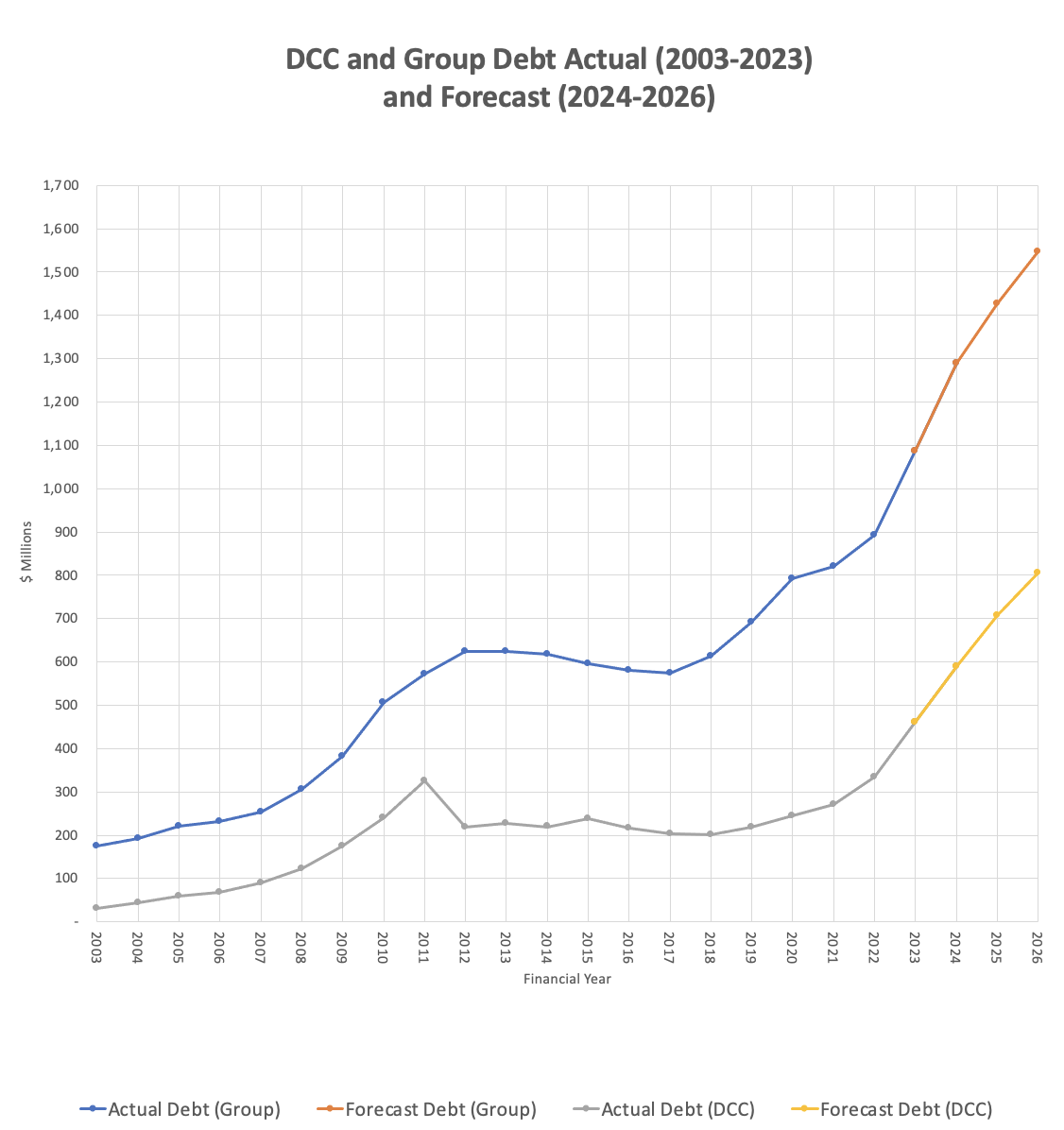
I voted against raising the debt cap from $1.2 BILLION TO $1.6 Billion last year, but indications are that even that may not be enough in two years time if we don’t sell Aurora.
“Town Hall may need scaffolding for years | Otago Daily Times Online News (odt.co.nz)
Construction hoardings and scaffolding around Dunedin’s town hall complex could be in place for more than five years while remediation work is carried out.”
The Municipal Chambers only took 2 years for the entire build.
The Town Hall itself took less than 2 years to build, foundation stone 3 March 1928 – opened 15th Feb 1930 and was built without any debt!
From Wikipedia “The City Council’s profits from its trading departments during the 1925-1926 South Seas Exhibition enabled it to undertake the project and pay for it with cash”
Finally we now have a proposal to get a return from this long dysfunctional public investment.
ODT 14/03/2024 “In 2021, Cr Lee Vandervis argued the council should consider selling some of its companies, including Aurora Energy. Cr Vandervis suggested the council allow another party to run the companies “properly, because we have failed”.
Full ODT front page story is published behind a paywall so I can not provide a public link.
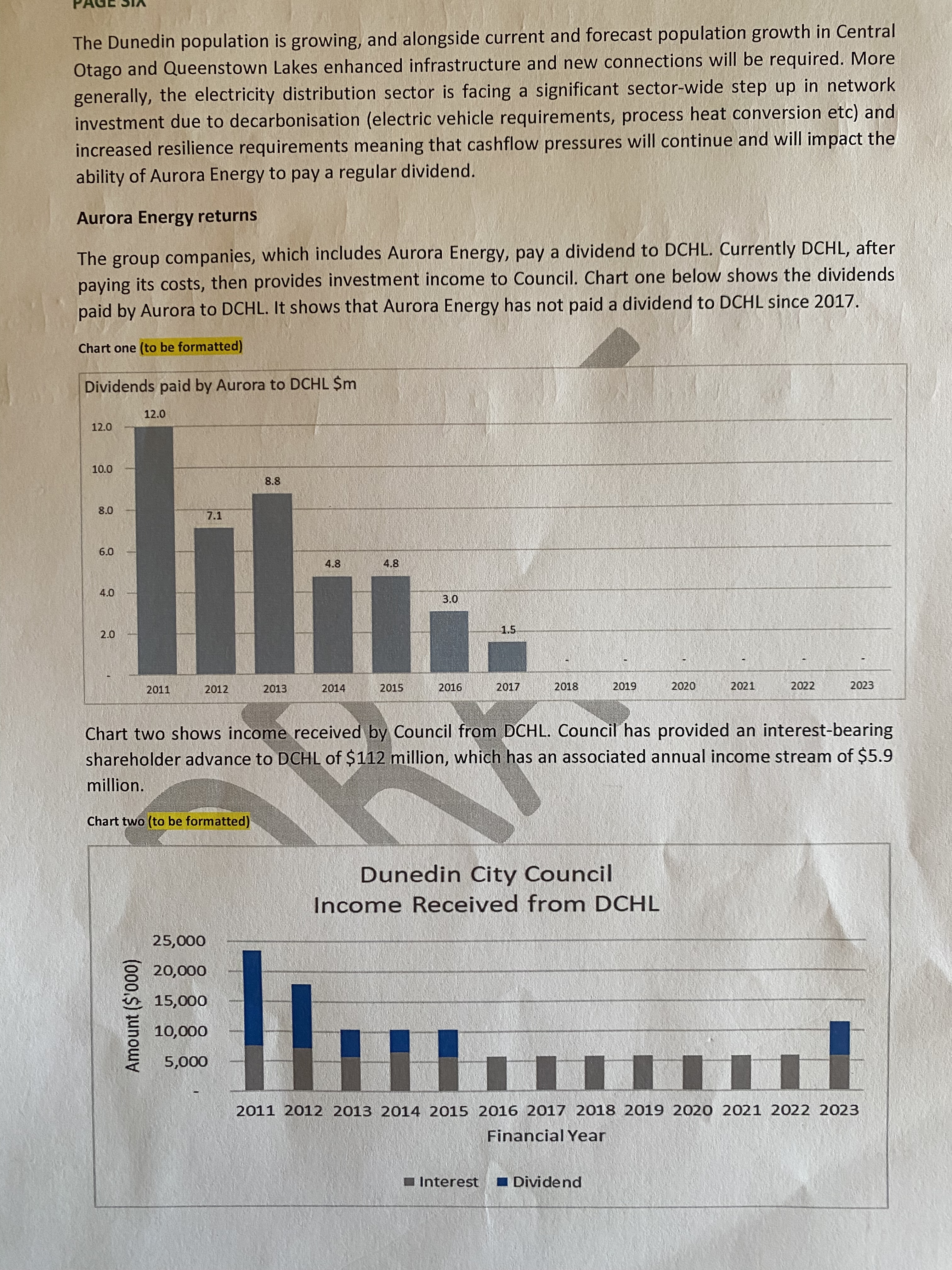
Posted inUncategorized|Comments Off on DCC Electricity Distribution company Aurora issues have been noted on this blog since October 2019.






 poonzteam5443March 22 David Farrar writes – The


 Lee Vandervis - lee@vandervision.co.nz
